Former Toyosato Elementary School (1)
A little while ago, I wrote an article about the main building of the former Toyosato Elementary School in Toyosato Town, Shiga Prefecture.
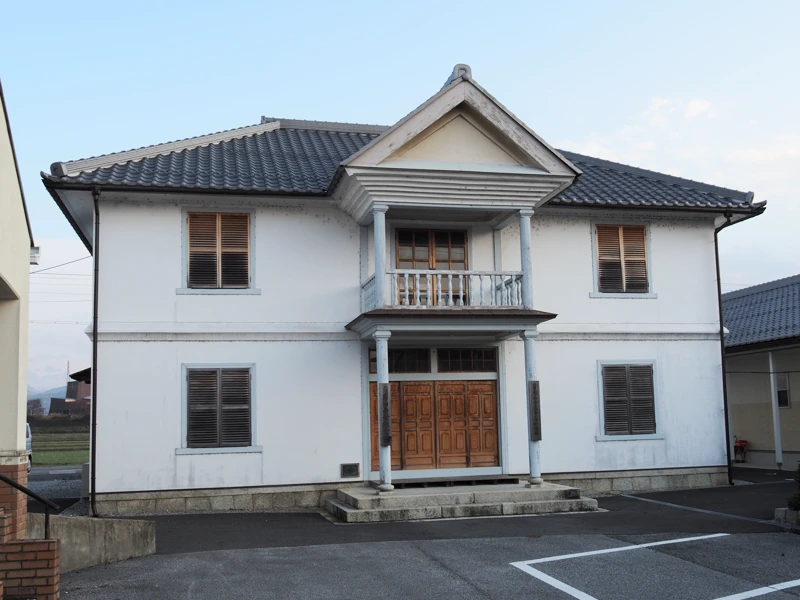
The photo shows the main building of the school constructed in 1887. When the school was in use, classroom wings stood to the left and right of the main building, but only this structure remains today.
By the early Showa period (around 1935), the student population at Toyosato Elementary School had grown to over 600, making the existing school buildings and grounds insufficient. Toyosato Village was thus compelled to rebuild the school. Furthermore, changes to the school district boundaries during the Meiji era had shifted the school’s location away from the village center, leading to calls for relocating the school.
Amidst these circumstances, in May 1935, an offer was made to donate land, buildings, and facilities for the school. The donor was Furukawa Tetsujiro (1878-1940), a native of Toyosato Village who served as Managing Director of Marubeni Corporation at the time.
Furukawa purchased land approximately 400 meters southwest of the original school and donated it to the village.
Design and supervision were handled by the Vories Architectural Office in Omihachiman, with construction carried out by Takenaka Corporation of Osaka.
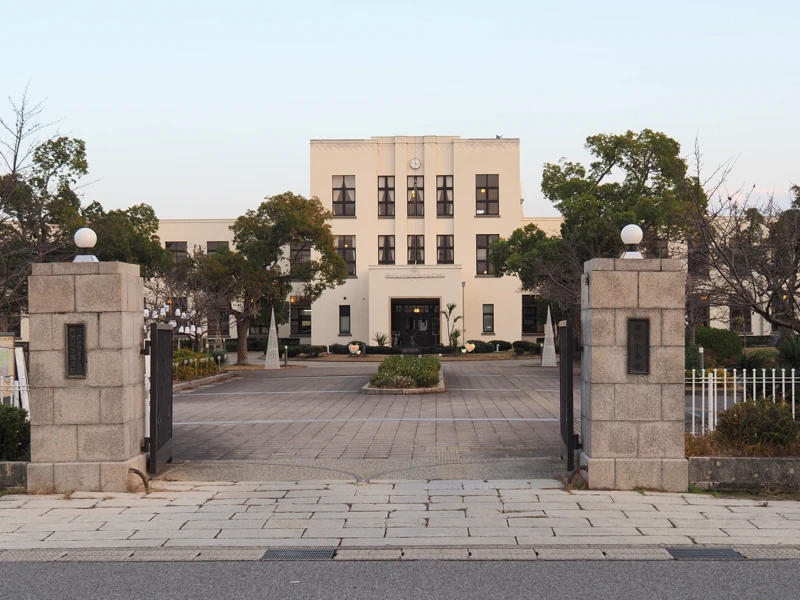
Construction of the school building commenced in March 1936 and was completed in May 1937.
The site covered approximately 38,200 square meters and featured a reinforced concrete main building (3480 m2), auditorium (684 m2), Shutoku Memorial Library (618 m2), steel-framed gymnasium (568 m2), wooden youth school building (859 m2), and a swimming pool.
The land to the left and right of the school gate was used as a training farm (paddy fields and dry fields).
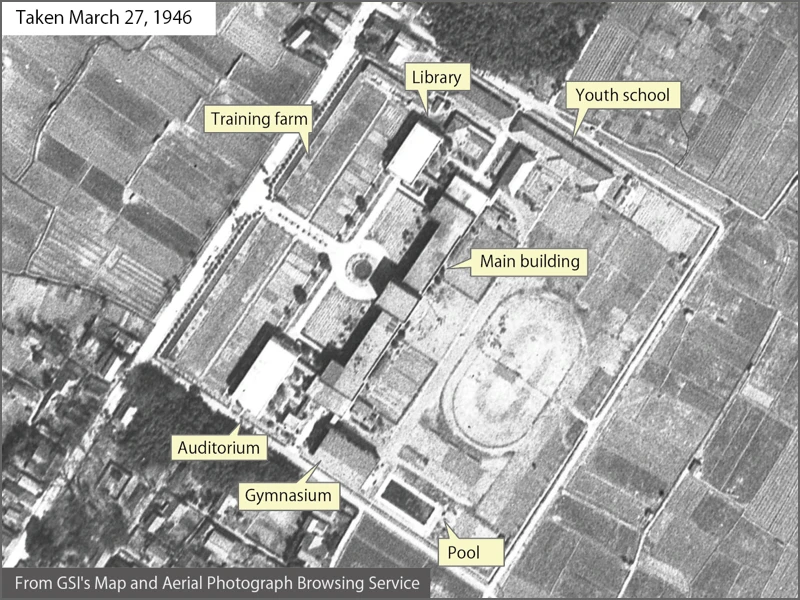
While the school grounds, buildings, and facilities were donated to Toyosato Village by Furukawa personally, the library alone was donated by “Furukawa as representative of the Shutoku Association” to the Toyosato Saibikai Foundation. The Shutokukai was an organization established to honor the memory of Marubeni founder Ito Chubei (1842-1903). The Toyosato Saibi Foundation is a foundation established by the second-generation Ito Chubei (1886-1973) to carry out social welfare activities.
On the northern side of the grounds stands the Youth School building. The Youth School was an institution established in 1935 to provide social education for young people who entered the workforce after elementary school without pursuing further academic studies. The standard course lasted two years (ages 12-13), while the main course lasted five years (ages 14-18) (grades 4-5 of the main course were for boys only).
Previously, social education was provided by vocational supplementary schools (offering practical training to working youth) and youth training centers (providing moral education and military training to males aged 16 and over). This school was established by consolidating and reorganizing these two types of institutions due to overlapping functions. As the war began, it became integrated into the wartime system, conducting labor mobilization under the guise of “vocational training.”
It was abolished following the enactment of the School Education Act in 1947.
The youth school, gymnasium, and pool shown in the photo above no longer exist, but the main building, library, and auditorium remain today.
Note that Toyosato Town began using a new school building constructed in 2004, so this building is no longer used as a school. The school building reconstruction issue caused quite a stir, but I’ll write about that another time if the opportunity arises.
A map is located beside the school gate.
Currently, the main building houses town facilities such as the town library and a child-rearing support center.
The former library building now serves as a tourist information center.
The buildings are open for viewing from 9:00 AM to 5:00 PM. However, it is closed on Mondays.

I arrived at the front of the main building.
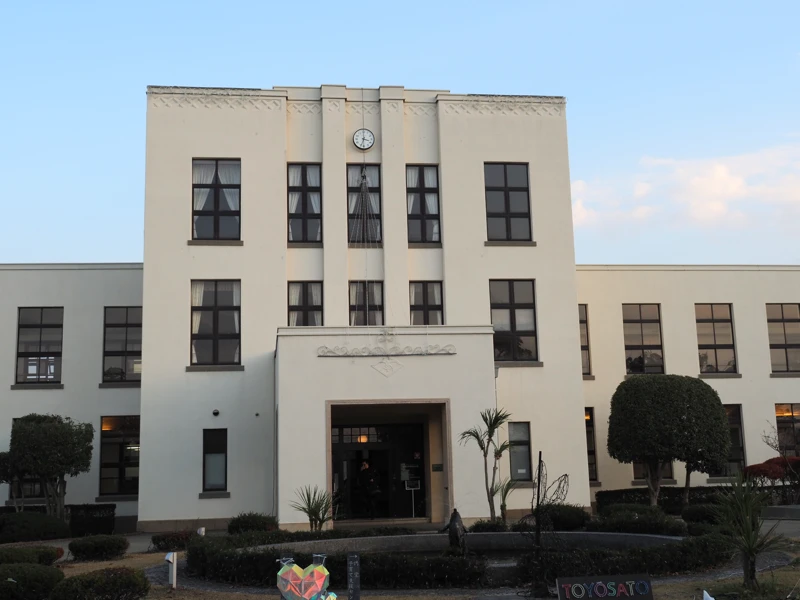
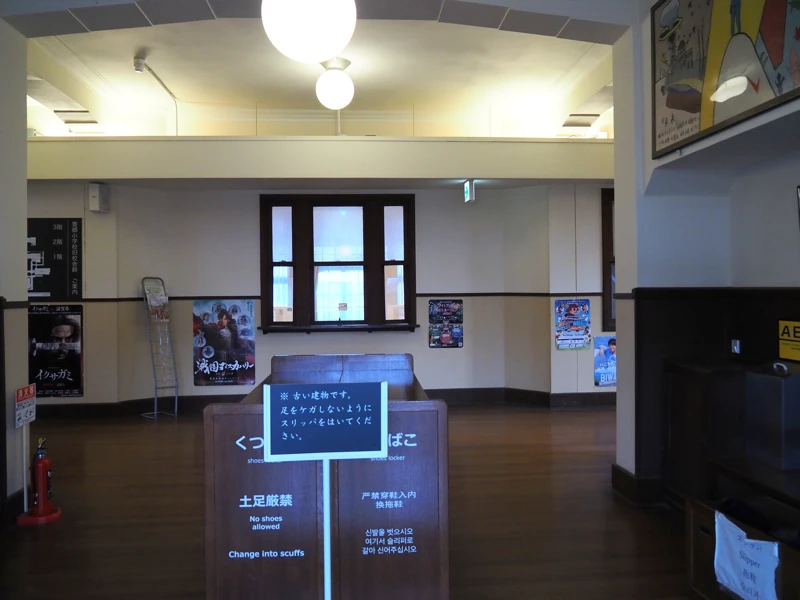
Please remove your shoes in the entrance hall. Directly ahead is the reference room, displaying a model of the school building and materials related to its construction.
The first-floor hallway. The indirect lighting is beautiful. But this definitely isn’t original to the building’s construction, is it?
(Apparently, during renovations, they created these protrusions to conceal utility piping and installed indirect lighting.)
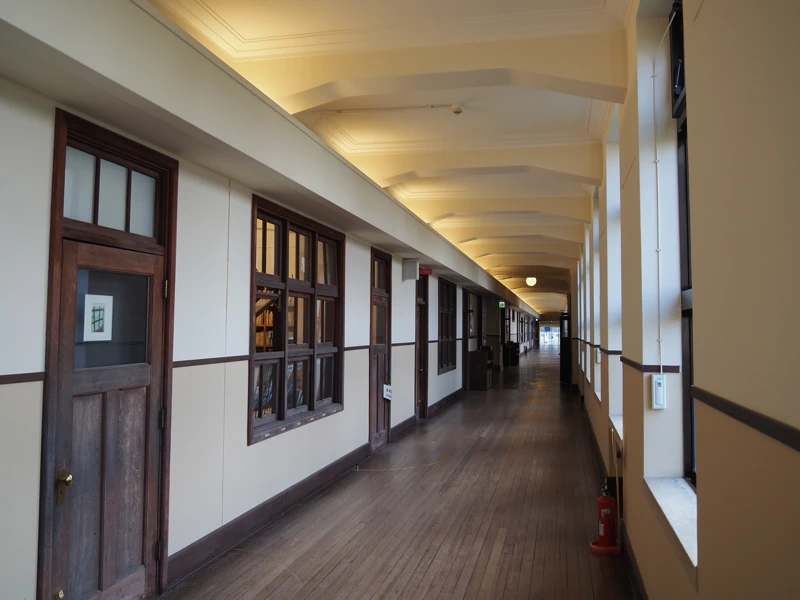
Since the first floor houses town facilities like the municipal library and childcare support center, quiet walking in the hallway is required.
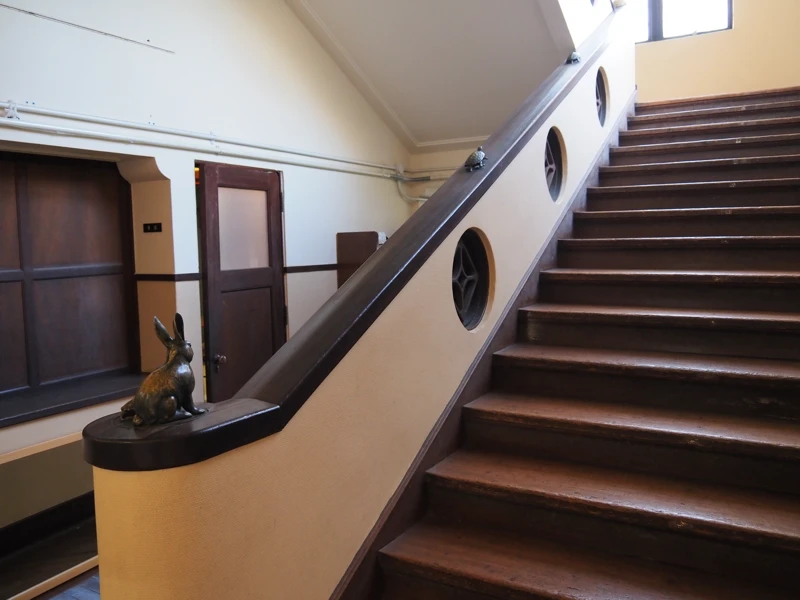
There are three staircases: one central and two on either side. They feature sculptures of the tortoise and the hare.
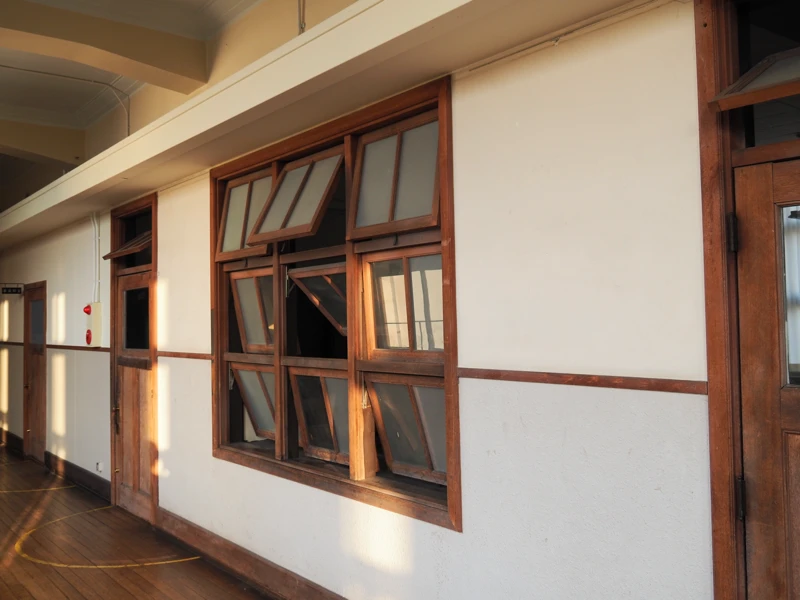
Second-floor hallway. This photo better shows the protrusions concealing the hallway’s utility pipes. They jut out like eaves into the hallway.
The way the windows open is interesting too. Since having window frames protruding into the hallway would be dangerous, they open inward toward the classrooms. But I wonder if they’re a bit of a nuisance from the classroom side.
The topmost windows open outward since there’s no risk of children bumping into them.
The central section of the main building extends up to the third floor. The map labels it as a conference room and singing room, and it seems accessible inside.

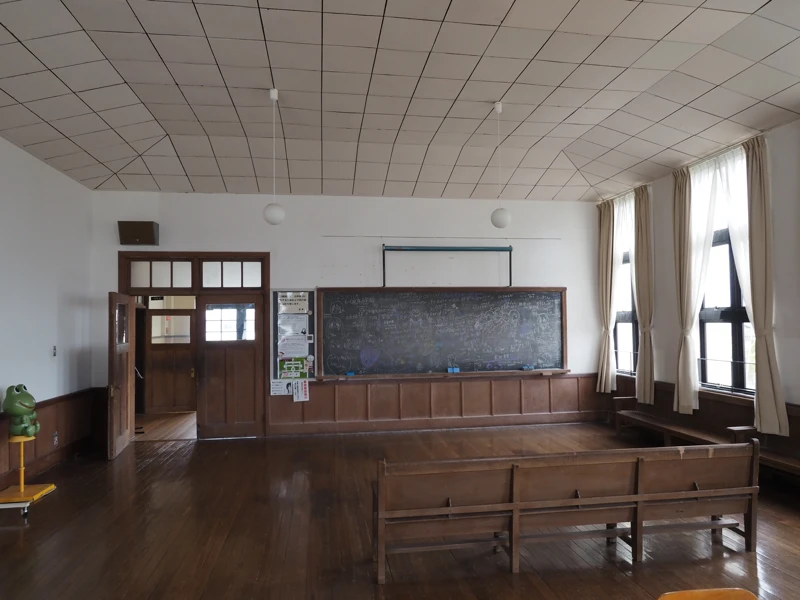
This is the conference room.
Fans often visit because this school building resembles the fictional high school featured in the anime “K-ON!”. Messages from visitors are written on the blackboard.
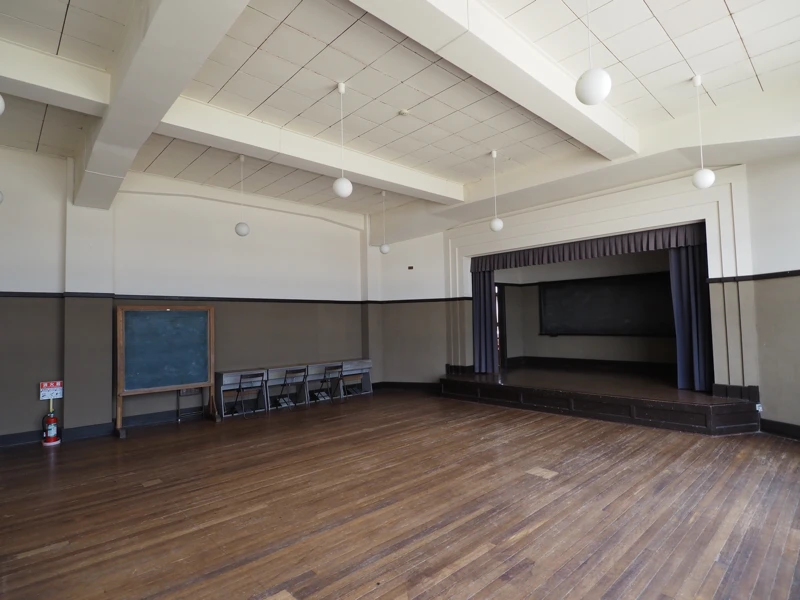
This is the adjacent singing room. It has a stage at the front.
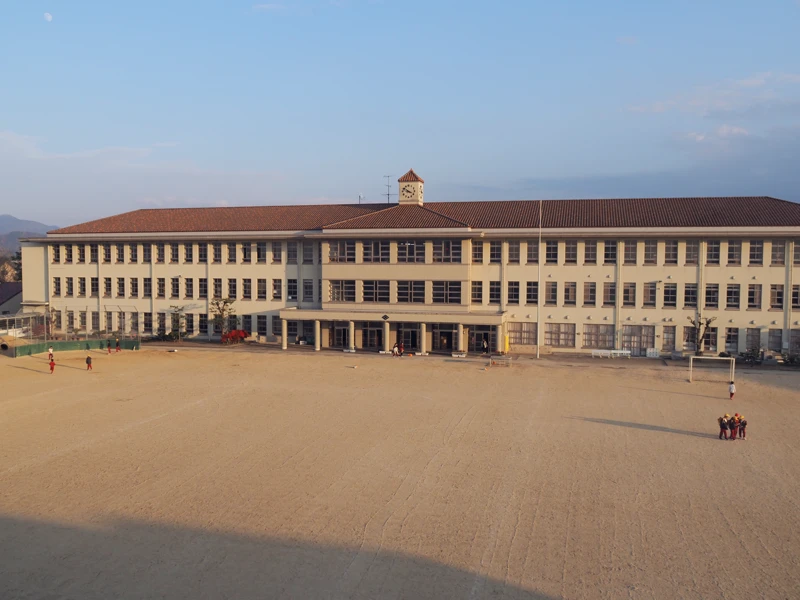
From the windows, you can see the current Toyosato Elementary School building.
Next, let’s take a look at the auditorium.
(To be continued.)
[Related article]
"Former Toyosato Elementary School Main Building" (2025-12-05)
[Reference]
“Toyosato Village history” (by Fujikawa Sukezo / Toyosato Village History Editorial Committee, Inukami County, Shiga Prefecture / 1963)
“Vories’ Architecture: Mission Utopia and the City’s Splendor” (by Yamagata Masaaki / Sogensha / November 1989)
“Shiga Prefecture Modern Architecture Survey Report” (edited by the Cultural Properties Protection Division, Cultural Affairs Department, Shiga Prefectural Board of Education / Shiga Prefectural Board of Education / March 1990)