Old Town of Tallinn
This article is preliminary research for pop-up cards I plan to create.
It is said that an Estonian fortress was built in Tallinn, now the capital of the Republic of Estonia, around the 11th century.
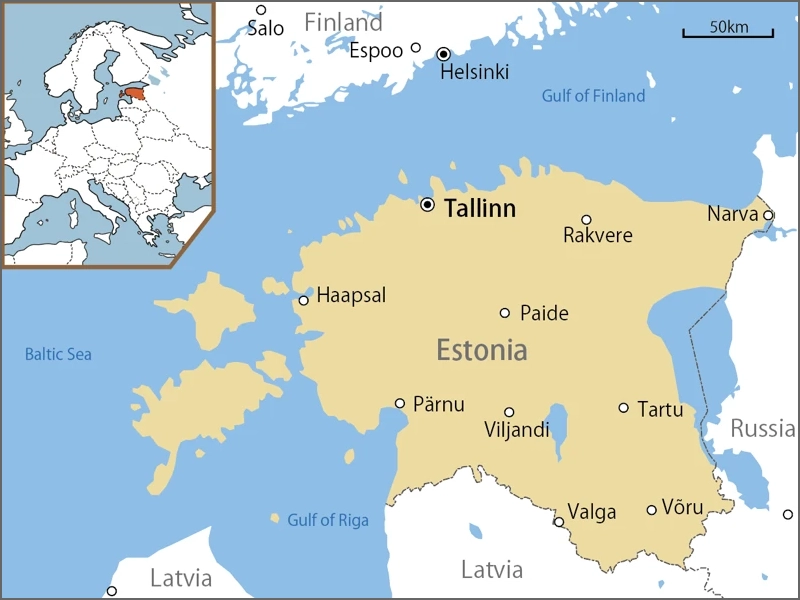
In 1199, the Pope authorized the dispatch of a crusade to spread Christianity in this region. In 1202, the Livonian Brothers of the Sword was formed in Livonia (the region spanning present-day southern Estonia to Latvia), advancing missionary work through military force.
While Christianization progressed in Livonia, resistance persisted in Estonia. Consequently, the Livonian Brothers of the Sword sought support from King Valdemar II of Denmark in 1218, subjugating Estonia from 1219 to 1220. Denmark built a castle on Toompea Hill in Tallinn during the first half of the 13th century.
From 1266 to 1282, Queen Margaret Sambiria (wife of Christopher I, son of Valdemar II) became the ruler of Tallinn. She ordered the construction of city walls, built by the Teutonic Order (the organization that absorbed the Livonian Order in 1237). Germans settled in Tallinn, and from the 13th to the early 16th century, it developed into one of the major centers of the Hanseatic League. (The city was then known as Reval.)
The prosperity of that era can still be seen in the surviving city walls, churches, public buildings, and merchant houses.
Due to its exceptionally well-preserved medieval town, Tallinn was inscribed as a World Heritage Site in 1997.
I created a map of Tallinn’s Old Town.
The Old Town is enclosed by approximately 2.5 km of city walls and is divided into Toompea, the hilltop area where nobles resided, and All-linn, the lower town where merchants and craftsmen lived.
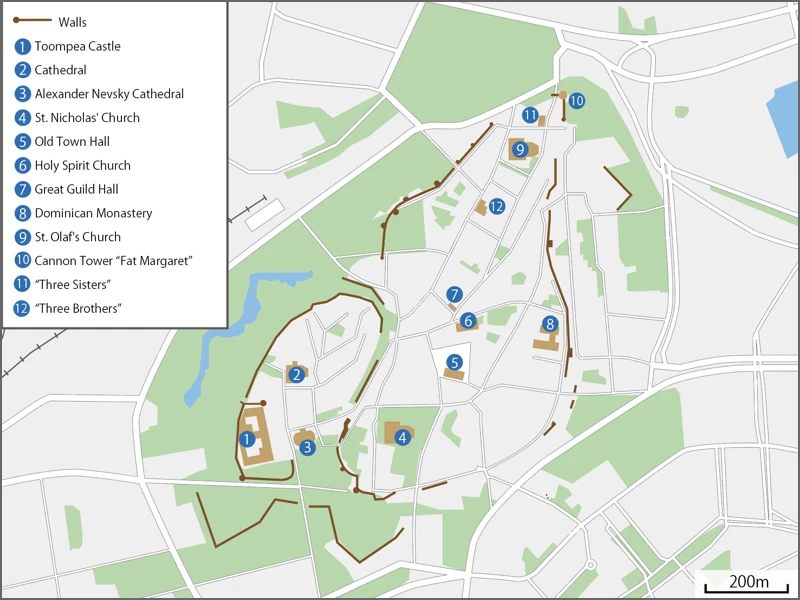
I’ve picked up several representative buildings.
(1) Toompea Castle is a castle built in the early 13th century.
It underwent renovations each time the ruler changed.
(2) The Cathedral was built shortly after the Danes occupied Toompea in 1219. It suffered a fire in 1684 but was subsequently rebuilt.
(3) Alexander Nevsky Cathedral was built in 1901 during the Imperial Russian era. So it is not included in the “Medieval Town” theme. Plans to relocate it existed when Estonia first gained independence, but they never materialized. It seems to be a building not particularly cherished by the citizens.
(4) St. Nicholas’ Church was built in the 13th century at the center of the German merchants’ quarter. Destroyed during the Soviet air raids of 1944, its original interior no longer remains.
(5) Old Town Hall. In 1248, Tallinn gained the rights of a free city and established a city council. The current building is an extension added in the 15th century to the structure originally built in the mid-14th century.
(6) Holy Spirit Church. Built in the 14th century as a chapel for the Town Hall and the Holy Spirit Brotherhood’s poorhouse.
(7) Great Guild Hall. Built in 1410, it was used for guild meetings and parties. The Great Guild held the highest status among Tallinn’s guilds; apparently, the mayor and city council members were all elected from its ranks.
(8) Dominican Monastery.
The Dominican Order had been proselytizing since the 13th century, but later became hated by the people due to the Inquisition and the sale of indulgences. It was destroyed by residents in 1524 and its activities were suspended by the city council the following year. It now appears to be open as a museum.
(9) St. Olaf’s Church. The church dedicated to Norway’s saintly king. It seems to have been built around the 13th century but suffered several fires. It was restored in 1840 and looks like this today.
(10) The cannon tower guarding the city entrance has the nickname “Paks Margareeta.” In English, this translates to “Fat Margaret”.
Built in 1529, the tower has a diameter of 24 meters and walls 4.7 meters thick.
Though not marked on the map, several other buildings have nicknames.
Three 15th-century merchant houses built side-by-side are called the “Three Sisters,” another residence is the “Three Brothers,” and one tower of Toompea Castle is known as “Tall Hermann.”
This article ended up sounding like I copied it straight from a tourist guide, but I plan to select a few of these buildings to create cards.
[References]
“Historic Centre (Old Town) of Tallinn ” (From the UNESCO World Heritage Convention official website)
“Globe-trotter Travel Guidebook: Baltic Countries 2019-2020 Edition” (Revised 12th Edition / Diamond Big Co. / 2019)
[Postscript]
(2026-03-07) I made some minor corrections to the map. I also added the locations of the buildings mentioned in the text as the “Three Sisters” and “Three Brothers.”