Former Ibaraki Prefectural Products Exhibition Hall
In my previous article, I wrote about the Ibaraki Kaikan (Hall), but I also mentioned the Ibaraki Prefectural Products Exhibition Hall that existed before the Hall was built.
So this time, I’d like to introduce that Products Exhibition Hall.
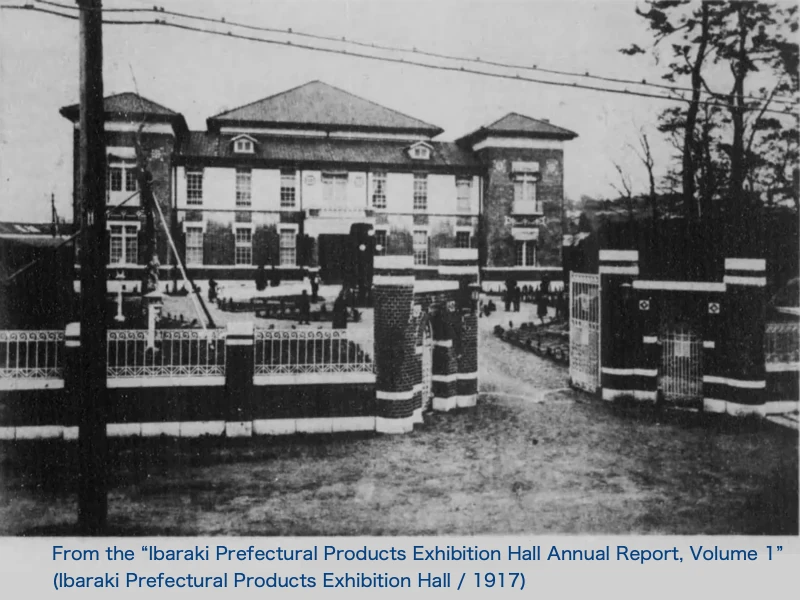
The Ibaraki Prefectural Products Exhibition Hall was completed in 1915. The photo shows the Products Exhibition Hall shortly after its completion.
During Meuji 30s (1897-1906), facilities called Product Exhibition Halls or Commodity Display Centers began appearing in various prefectures to promote local industry. Some were established not just by prefectures, but also independently by districts, cities, or chambers of commerce and industry.
These facilities aimed to foster industrial development by researching, introducing, and selling local and other prefectures’ products, as well as providing consultation for businesses.
Ibaraki Prefecture lacked such a facility at the time. Consequently, a proposal for establishing a Product Exhibition Hall was submitted to the prefectural assembly in 1910, and its establishment was approved in 1912.
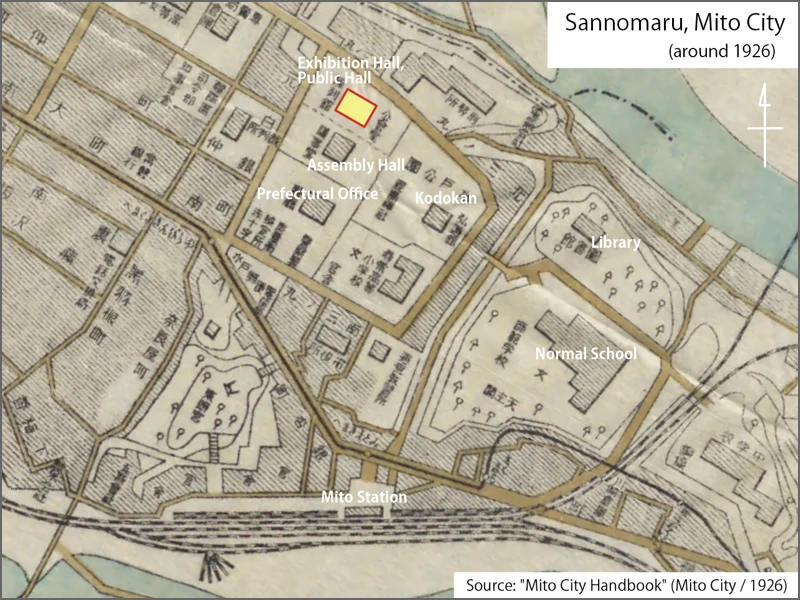
The site was secured in Sannomaru, Mito City, north of the Prefectural Assembly Hall, covering approximately 16,500 square meters.
The design was by Sato Sato (1878-1941), then a professor at Waseda University, and construction was handled by Aoki-gumi. They built a two-story structure with a wooden frame and brick exterior. Construction began in October 1913 and was completed in January 1915.
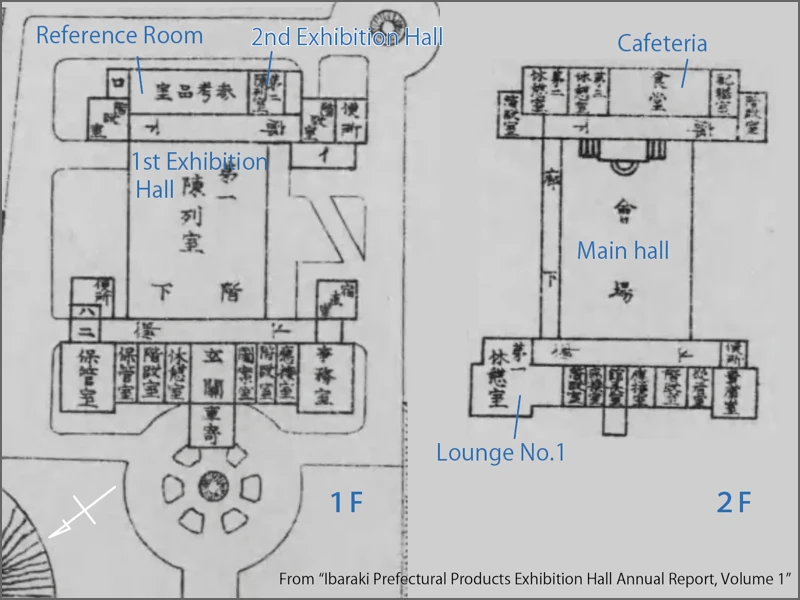
The first floor featured the First Exhibition Hall centrally, with the Second Exhibition Hall and Reference Room located further back. The front side housed rooms such as offices, reception rooms, and storage rooms to the left and right of the entrance.
The second floor centered on a large hall, which served as the public auditorium. Consequently, citizens often referred to the entire building as the Public Hall. Other second-floor facilities included a cafeteria, VIP rooms, the director’s office, and lounges.
The decision to place the public hall on the second floor stemmed from the understanding that, based on the situation in other prefectures at the time, a product exhibition hall would be ineffective without a venue for lectures and discussions. Nationally, exhibition halls constructed after the late Meiji period increasingly adopted a layout where the first floor housed exhibits and the second floor served as a public hall or assembly space.
After the building’s completion, the exhibition hall was handed over in April 1915. Preparations for operations followed, and the hall opened on July 7th. Construction costs totaled approximately 53,000 yen, furnishings cost about 20,000 yen, and miscellaneous expenses amounted to roughly 10,000 yen. Although a prefectural building, the city of Mito also contributed a donation of 4,000 yen toward its construction.
The first photo is black and white, so it’s hard to tell, but the roof was apparently red tile. The construction report states the walls were timber-framed brick, and the earthen floor and subfloor were poured concrete.
During the first two years after opening, partly due to its novelty and partly because of events like the Industrial Exhibition and the Products Fair, annual attendance was 157,054 in 1915 and 120,142 in 1916.
After that, annual attendance seemed to settle around 70,000 to 80,000 people.
The second-floor public hall, with a capacity of about 600 people, was used for various gatherings as well as events like concerts and art exhibitions.
It continued operating under the name “Ibaraki Prefecture Commodity Exhibition Hall” from 1921…
However, on the night of May 7, 1929, it was destroyed by fire.
The opening lines of the May 15th issue of the magazine “Geijutsu (Art)”, Volume 14, read as follows:
“Late on May 7th, the Ibaraki Prefectural Public Hall in Mito City caught fire. At the time, the Ibaraki Art Exhibition, hosted by the Ibaraki Shimbun (newspaper), was in progress in the hall on the second floor. The next morning, local newspapers were quick to report that all the numerous exhibits had been reduced to ashes.
Numerous artists hailing from Ibaraki Prefecture, including Yokoyama Taikan, Kimura Buzan, Hida Shuzan, Ogawa Usen, Goto Koho, and Nagata Shunsui, were renowned figures in the Tokyo art world. Thus, though it might seem like a regional exhibition, it was actually a highly regarded event within the annual calendar of Japan’s art community.
(…omitted…) I had heard that splendid works were once again being displayed in abundance this time. Upon learning of this fire, I felt utterly crushed, knowing that the painstaking efforts behind certain exhibits, the joy of the known award winners, and the paintings of those people too must have been lost in the smoke."
The text continues to note that Yokoyama Taikan’s work was taken out and survived, but it seems many other pieces were lost. According to the exhibition catalog from that time, 60 works were on display.
The above text is from an art magazine, so it only discusses the artwork. I searched for other sources detailing the cause of the fire or the damage, but couldn’t find any.
In the prefectural assembly that July, the governor’s explanation merely stated: “On the night of May 7th, the Prefectural Commodity Exhibition Hall and Public Hall caught fire and burned to the ground. We are currently studying countermeasures and hope to seek cooperation at a later date.”
In November of that year, the Imperial Army Special Grand Maneuvers were held in Ibaraki Prefecture. Records from this event note, “The Imperial carriage and horse stables were located at the site of the former Ibaraki Prefectural Commodity Exhibition Hall.” It appears the site had already been cleared by this time.
After the public hall (Commodity Exhibition Hall) burned down, the 1931 prefectural assembly approved rebuilding a new structure to serve as the next public hall. The building completed in 1935 was the Ibaraki Kaikan mentioned in the previous article.
[Reference]
“Ibaraki Prefectural Products Exhibition Hall Annual Report, Volume 1” (Ibaraki Prefectural Products Exhibition Hall / 1917)
"Ibaraki Prefecture Commodity Exhibition Hall Bulletin" (Compiled by Ibaraki Prefecture Commodity Exhibition Hall / Ibaraki Prefecture Commodity Exhibition Hall / 1924)
“Geijutsu (Art)" No. 14 (Greater Japan Art Association / May 1929)
"History of the Ibaraki Prefectural Assembly, Volume 4 “(Compiled by the Ibaraki Prefectural Assembly History Compilation Committee / Ibaraki Prefectural Assembly / 1966)
"Research on Modern Japanese 'Exhibition Halls’ ” (by Miyake Takuya / Shibunkaku Publishing / 2015)