Hakuunkan
Hakunkan in Omihachiman City stands across the road from the torii gate of Himure Hachimangu Shrine.
This concludes the guided tour. We said our goodbyes to the guide inside the building and dispersed.
Now, let me introduce this building.
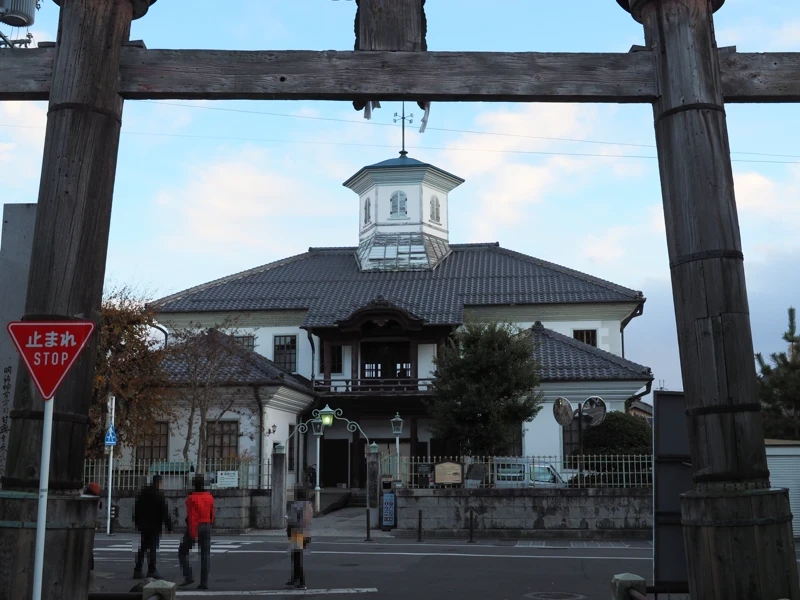
In 1872, the Meiji government promulgated the Education System. In response, Hachiman Town opened Hachiman-higashi School the following year, using a temple as its school building, and Hachiman-nishi School, using a private residence as its school building.
In 1876, Hachiman-higashi School began construction on a new school building, which was completed in April 1877. This is that building. The master carpenter was Takagi Sakuwemon, a local craftsman, and the construction cost was reportedly 6,000 yen. It was called “Hakuunkan” from the time it was built.
Meanwhile, Hachiman-nishi School continued using a private residence that had been purchased and expanded.
In 1886, the two schools were nominally merged. Hachiman-higashi School became the Advanced Course Hachiman Elementary School, while Hachiman-nishi School became the Regular Course Hachiman Elementary School. Subsequently, in March 1889, both schools were combined to form the Advanced and Regular Course Hachiman Elementary School, with Hakuunkan serving as the main school building.
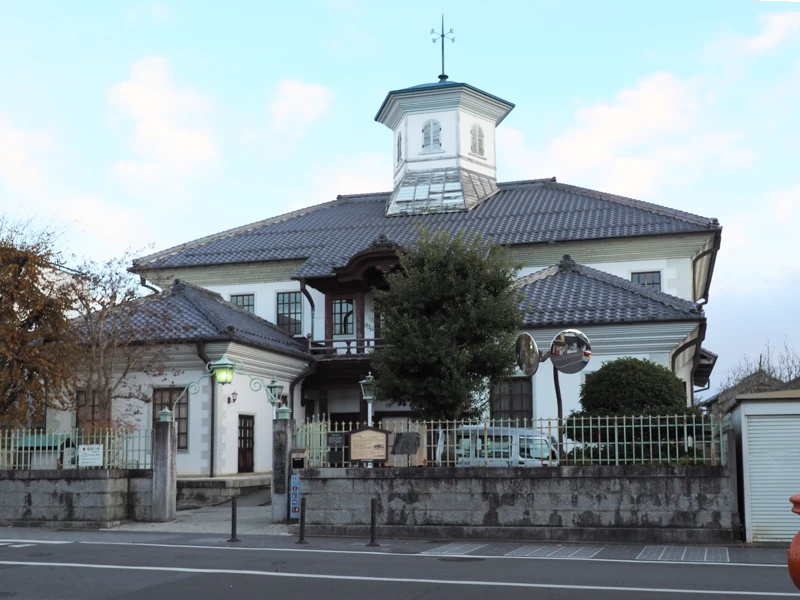
However, due to the large number of students, the school building became too small, and in 1893, a new school building was constructed and the school relocated. Therefore, this building was only used as a school for for a little over ten years.
In 1895, the Hachiman Town Office moved into this building.
Although the exact timing is unclear, it seems the drum tower was removed when it began serving as the town office.
Later, in 1900, at the request of the county, it was used as the Gamo County Office until April 1923.
After ceasing to be the county office, it once again became the Hachiman Town Office and was used until around 1949.
From 1951, it served as a telegraph and telephone office and as the Hachiman Branch Office of the Food Agency, Ministry of Agriculture and Forestry. A photograph from that era exists, which is reproduced below. (Source: “Kanko” magazine, February 1997 issue)
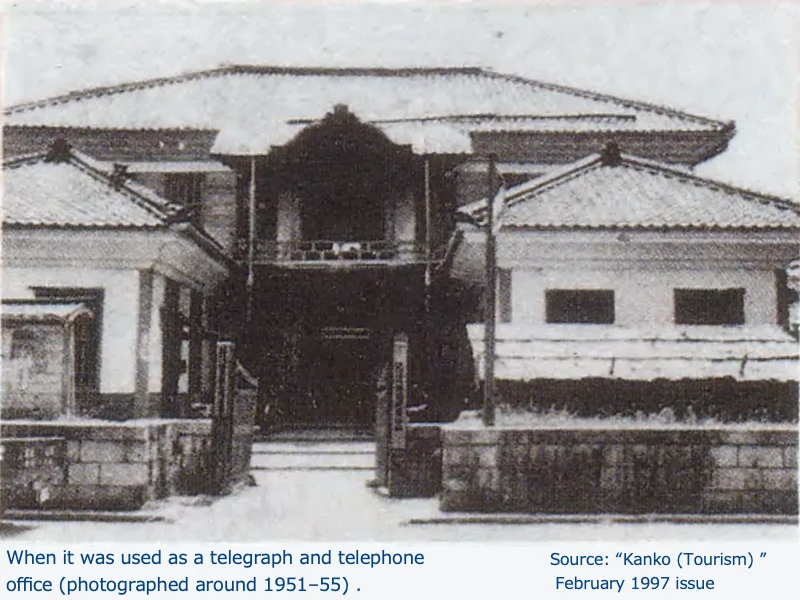
According to the magazine’s description, the photograph appears to have been taken in the 1950s, likely around 1951 to 1955.
Around 1965, Omihachiman City sold this building to a private owner due to financial difficulties. The purchaser intended to use it as a store but was unable to do so. While occasional maintenance was performed, it appears the building was simply held in a state of vacancy.
I guess this photograph was taken around 1989 and am publishing it here. (Source: “Shiga Prefecture Modern Architecture Survey Report,” 1990)
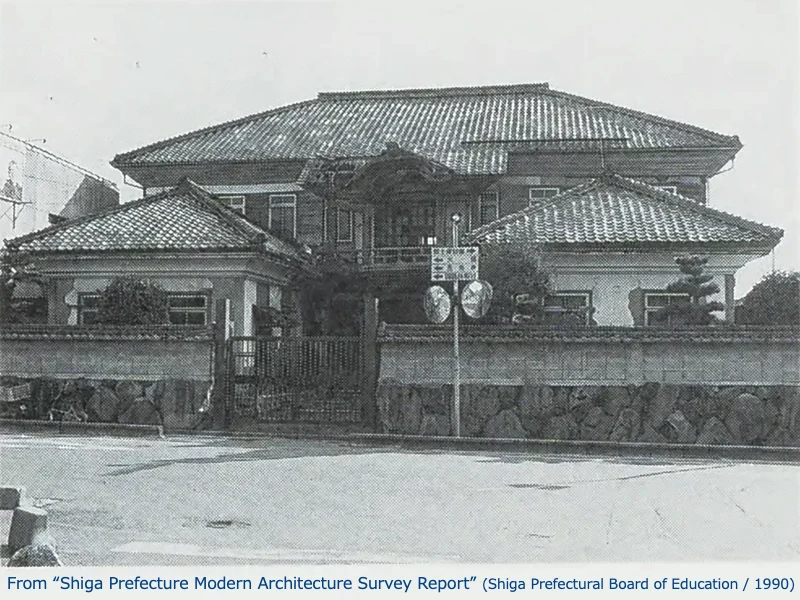
Looking at this, you can see the central eaves section has collapsed.
The plaster has peeled off the walls on the left and right at the front. The wooden paneling on the second-floor walls appears not to be original; it seems boards were nailed over the plaster walls later.
Later, the city considered using the building as a tourist facility. In 1992, the city acquired ownership of the building and began restoration work on Hakuunkan.
The Architectural Research Association, commissioned for the project, documented the building that same year and created a restoration plan.
During the restoration planning phase, they debated whether to restore it to its original state upon construction or just restore the exterior. It was decided to restore only the exterior. Reasons included that restoring only the exterior would be more practical considering future use, and that significant internal alterations made it difficult to ascertain the original form.
The road in front of the building had been widened in 1971, reducing the space in front of the entrance. Consequently, the building was jacked up and moved 4 meters south.
The drum tower was reconstructed based on old photographs and traces found in dismantled components.
Thus, in June 1994, it opened as the regional information center “Hakuunkan.”
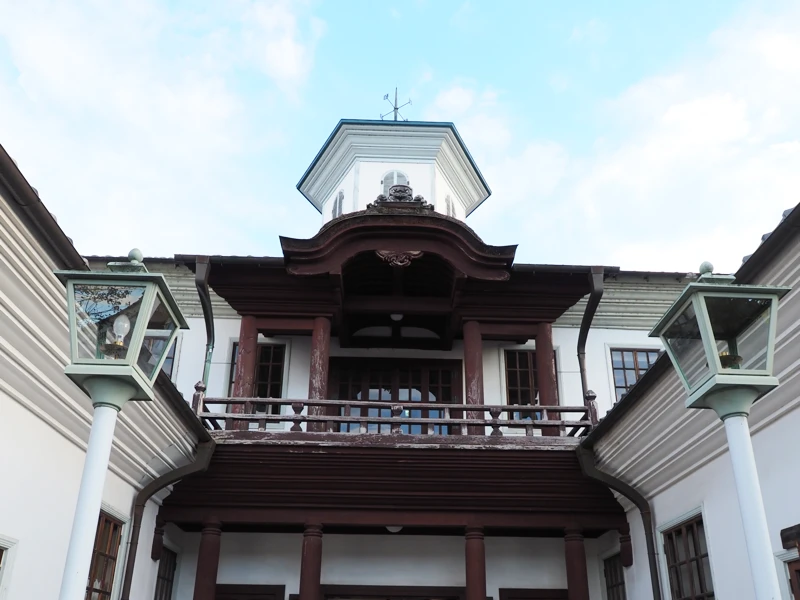
The first floor houses a tourist information center, so I refrained from taking photos inside. The second floor is open to citizens as a paid rental space, but it wasn’t in use that day, so I took photos.
Ascending the stairs, they split left and right at the top.
Stained glass windows adorn the back wall. This appears to be one of the building’s highlights.
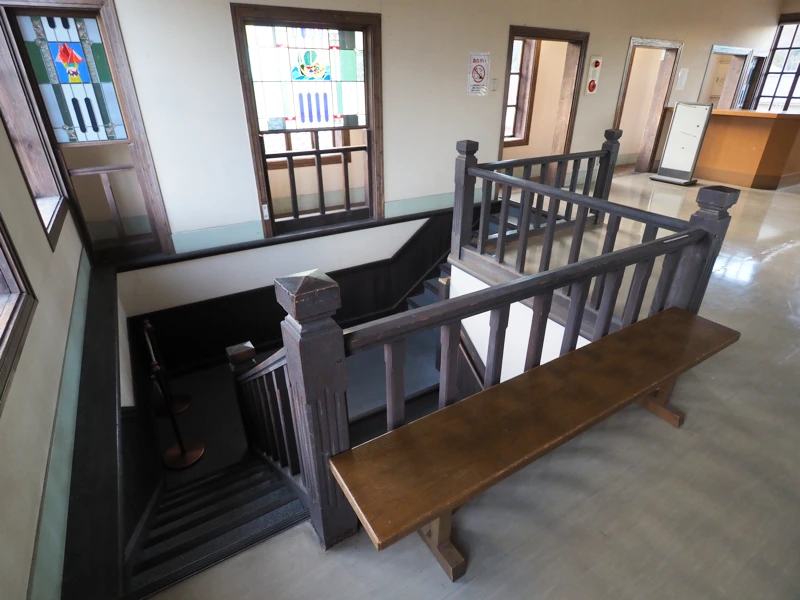
The interior has a modern design.
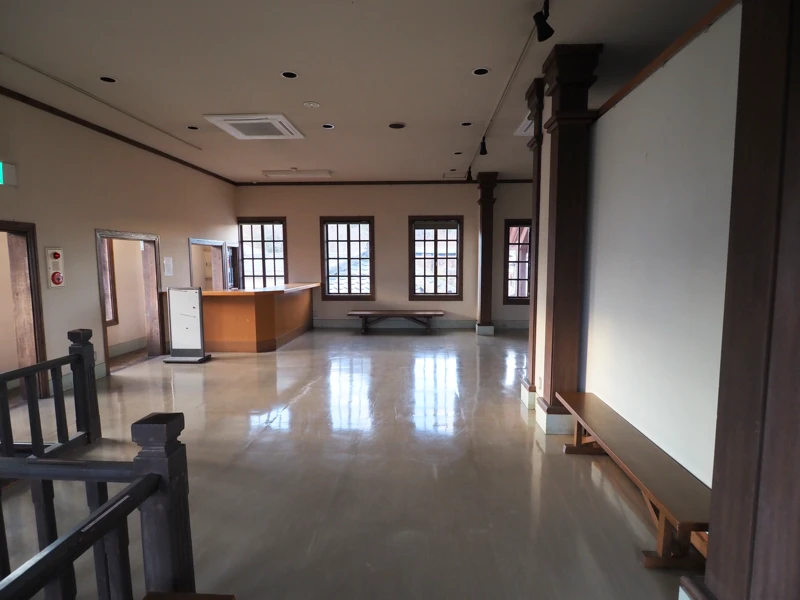
The large window on the left is the central front of the building. To its right is an open space with tables and chairs arranged.
Near the right pillar is something resembling a wooden panel wall, but this is not a wall; it was a display shelf. Its top does not reach the ceiling.
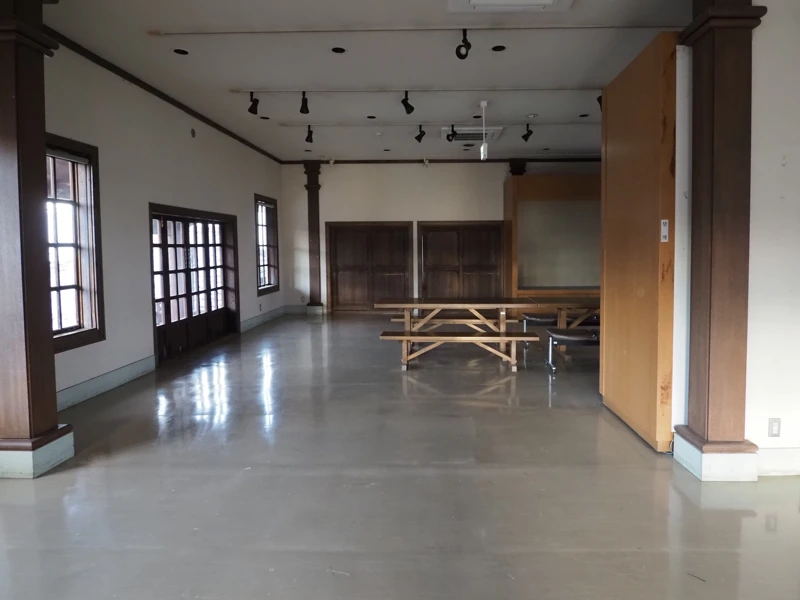
I went to near the large window in the photo above and took this shot facing right.
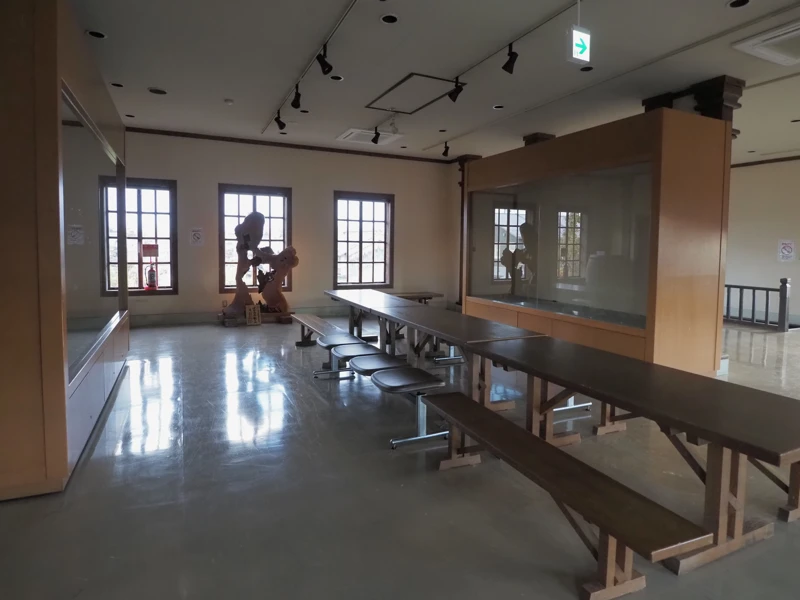
This should be the center of the building. The drum tower should be above this ceiling, but it seems they didn’t build stairs to reach it.
Since they prioritized utilizing the building, I think this is fine as it is. The drum tower itself is a reconstruction anyway.
The wall to the left upon exiting the entrance. There was a sign for the “Omihachiman Tourism and Products Association” and a display for the “Hakuunkan Office”.
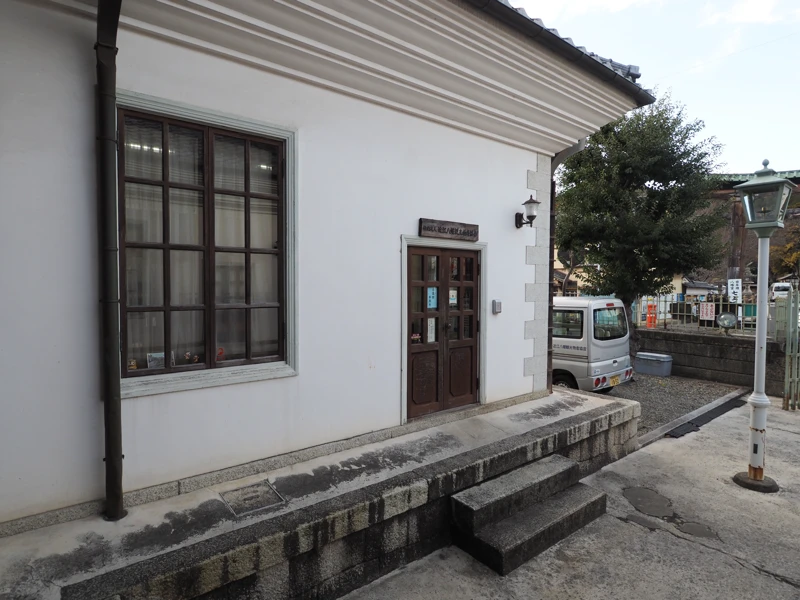
In 1998, Hakuunkan was registered as a Tangible Cultural Property.
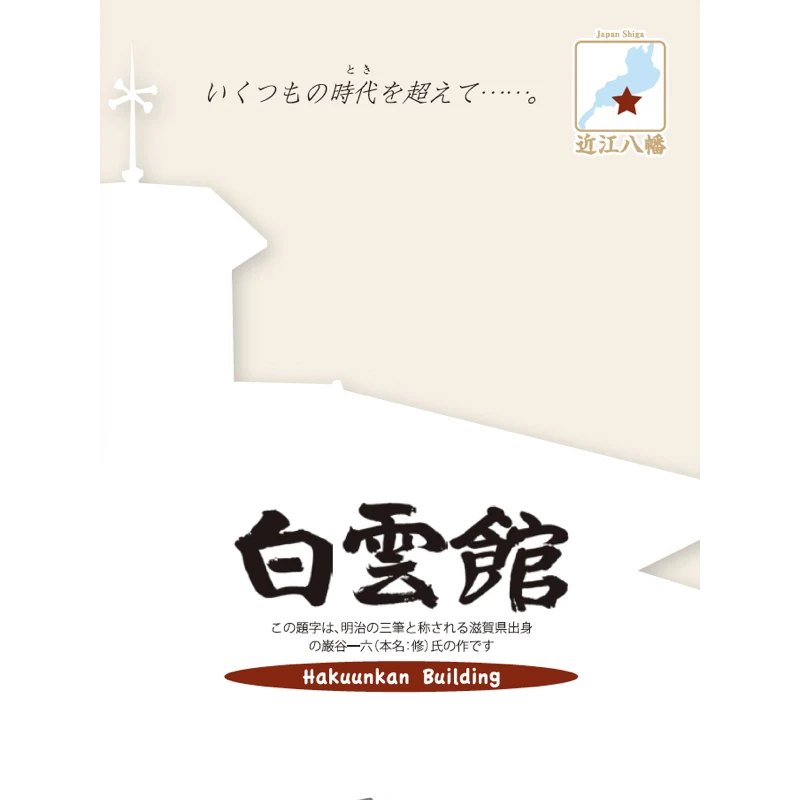
I didn’t know this during my visit, but the characters for “Hakuunkan” used on the pamphlet were written by Iwaya Ichiroku (real name Shu) (1834-1905). There seems to be a plaque inside the building, but I didn’t notice it. (Image: Top half of the pamphlet cover)
I remembered him as the person who wrote the plaque for the former Kakuichi School in Sakaki Town, Nagano Prefecture, but apparently he was born in Minakuchi, Koka County, Omi Province (present-day Koka City, Shiga Prefecture). He served as a clerical official in the Meiji government and later became a member who was appointed of the House of Peers. It seems he accepted calligraphy commissions whenever possible, leaving works and inscriptions throughout the country.
I heard that many of his calligraphic works are also preserved in Omihachiman.
[References] (All written in Japanese)
"History of Hachiman Town, Shiga Prefecture: Volumes I and II" (Compiled by Hachiman Town, Gamo County, Shiga Prefecture / Hachiman Town / 1940)
“Street Corner Renaissance: Western Architecture Alive in the Lake Country (Omi Bunka Sosho; 24)” (Masuda Koichi, ed. / Sunbright Publishing / 1986)
“Shiga Prefecture Modern Architecture Survey Report” (edited by Shiga Prefectural Board of Education, Cultural Properties Protection Division / Shiga Prefectural Board of Education / 1990)
"Kanko (Tourism)" February 1997 issue (Japan Tourism Association)
“The Restoration of Hakuunkan in a City of History and Tradition” (by Hirata Fumitaka / published in “Journal of the Architectural Research Association” No. 1 / 2001)
“Omihachiman City Newsletter” October 2021 Issue (Omihachiman City General Policy Department, Secretariat and Public Relations Section / 2021)