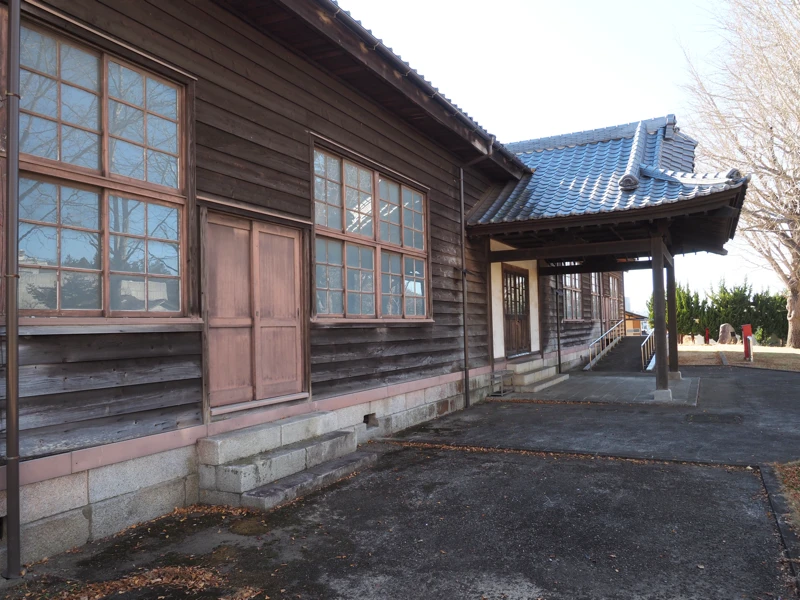
Former Mito Agricultural High School Main Building (1)
This time, I’ll talk about the Ibaraki Prefectural History Museum again. This building stands on the museum grounds.
It’s located about 100 meters from the former Mitsukaido Elementary School Main Building I wrote about last time.
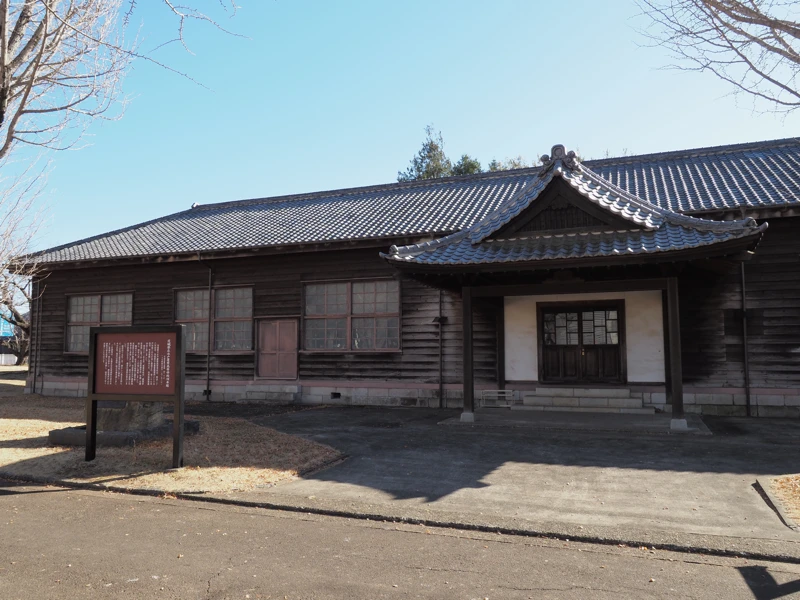
The explanatory plaque on the left side of the photo reads: “Former Main Building of Ibaraki Prefectural Mito Agricultural High School.”
The reason this building is here is that the site where the Prefectural History Museum was built was originally the grounds of Ibaraki Prefectural Mito Agricultural High School.
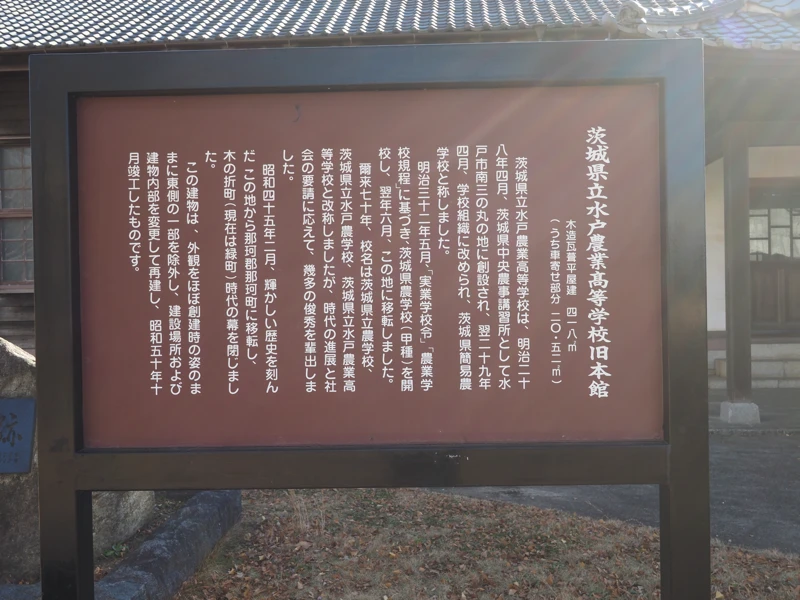
The agricultural school existed on this site for approximately 70 years, from 1900 until February 1970.
The history of Mito Agricultural High School began with the opening of the Ibaraki Prefectural Central Agricultural Training Center in 1895. It was located in Sannomaru, Mito City, near the current Mito Police Station. The center utilized the existing buildings of the Industrial Exhibition Hall (established in 1888) that stood there.
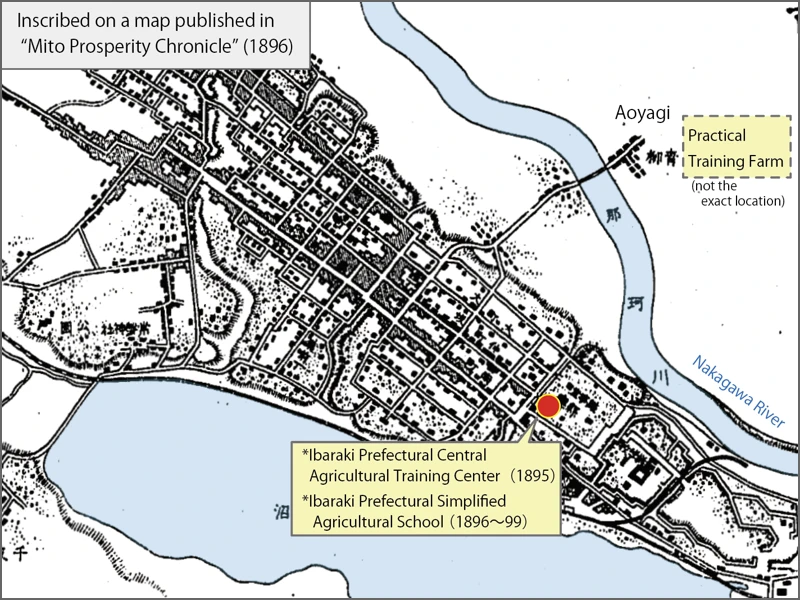
For practical training, approximately one hectare of farmland—combining paddy fields and dry fields—was prepared in Aoyagi, Yanagawa Village, Naka County (present-day Aoyagi-cho, Mito City), across the Nakagawa River.
However, the training center’s short learning period was deemed less effective than formal schooling. Consequently, the center was abolished the following March, and the Ibaraki Prefectural Simplified Agricultural School was established. Another reason was that becoming a school would allow it to receive national treasury subsidies.
All buildings and other facilities were inherited from the training center.
In February 1899, the “Vocational School Ordinance” and “Agricultural School Regulations” were promulgated, requiring the Simplified Agricultural School to reorganize into either a Class A Agricultural School or a Class B Agricultural School. (Class A was for graduates of higher elementary schools; Class B was for graduates of ordinary elementary schools.)
During this review process, opinions emerged that new school buildings and an expanded scale were necessary. Consequently, it was decided to construct new school buildings in Tokiwa, Tokiwa Village (present-day Midori-cho, Mito City), west of Mito City, and relocate there.
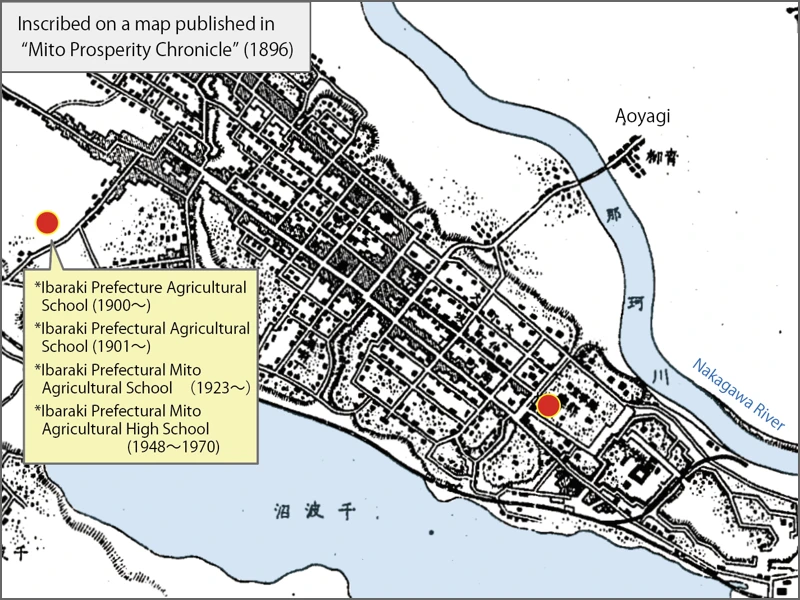
Ibaraki Prefectural Simplified Agricultural School became a Class A Agricultural School in May of the same year and was renamed Ibaraki Prefecture Agricultural School. Then, in June of the following year, 1900, it relocated to a newly constructed school building. This is the school building that remains today.
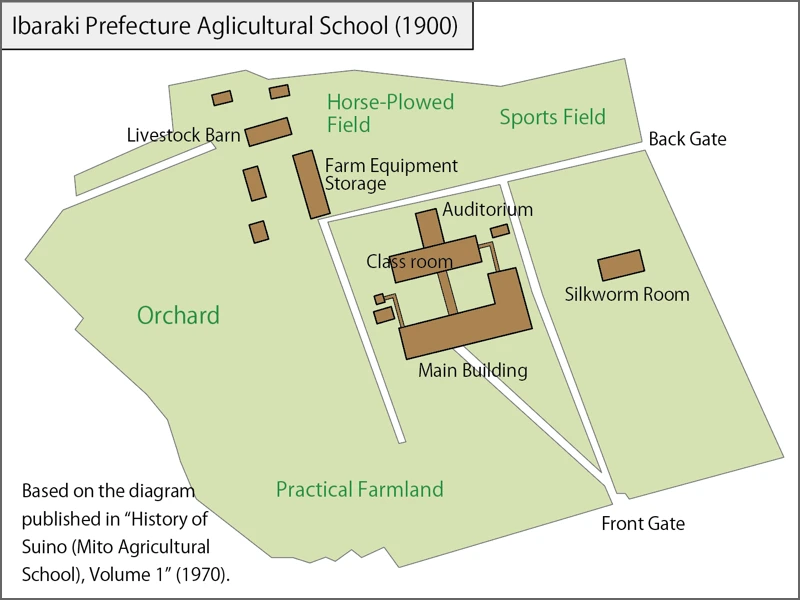
The school grounds at the time of relocation were as follows:
The main building and classroom building stood, with an auditorium located north of the classroom building. To the east was the silkworm rearing room, while the west side comprised the practical farmland and orchard. Along the north side were the farm equipment storage, livestock barns, fertilizer storage, and warehouses.
In 1918, the Sericulture course was established, and the original main course was renamed the Agriculture course.
The school’s enrollment capacity became 450 students.
In April 1923, the county system was abolished, and the county-run agricultural school was transferred to the prefecture. As six new schools became prefectural agricultural schools, this school changed its name to “Ibaraki Prefectural Mito Agricultural School.” The following year, the alumni association also changed its name to “Suino Alumni Association”. (“Suino is the abbreviated form of the Mito Agricultural School.) Even today, the school’s abbreviated name “Suino” is still in use.
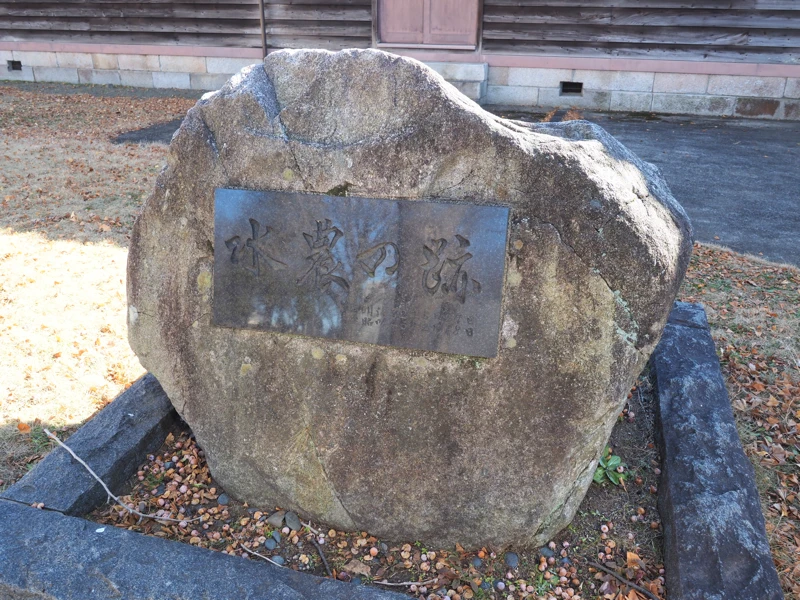
A monument inscribed “Site of Suino” stands in front of the main building. It was erected in 1975 as part of the 70th anniversary commemorative project.
During the Imperial Japanese Army’s Special Grand Maneuvers in 1929, the school buildings served as a office for the General Staff Headquarters’ Horse Section and as lodgings for grooms. The athletic field became a horse tethering area where 500 horses were tethered.
From November 11th to the 24th, special daily duties included cleaning the school grounds, participating in events, and cleanup after.
During the war, students began participating in labor mobilization. From around 1938 to 1941, this involved a few days of labor service per year, but it later became student mobilization, with requests coming directly from the prefecture.
For example, in 1942, 20 students from this school were dispatched for three months as part of the Manchuria Construction Labor Service Corps.
In 1943, students were sent for two months as part of the Hokkaido Farming Assistance program. Students were also used for land consolidation, repair work, and farm labor within the prefecture.
In March 1945, the Decisive Battle Education Measures Outline was promulgated, followed by the Wartime Education Ordinance in May. This mandated that each school form a student corps to engage in increased food production, military production, and air defense.
At Mito Agricultural School, the student corps was formed on July 1st. In August, it was reorganized into a Combat Volunteer Corps in preparation for a potential U.S. military landing.
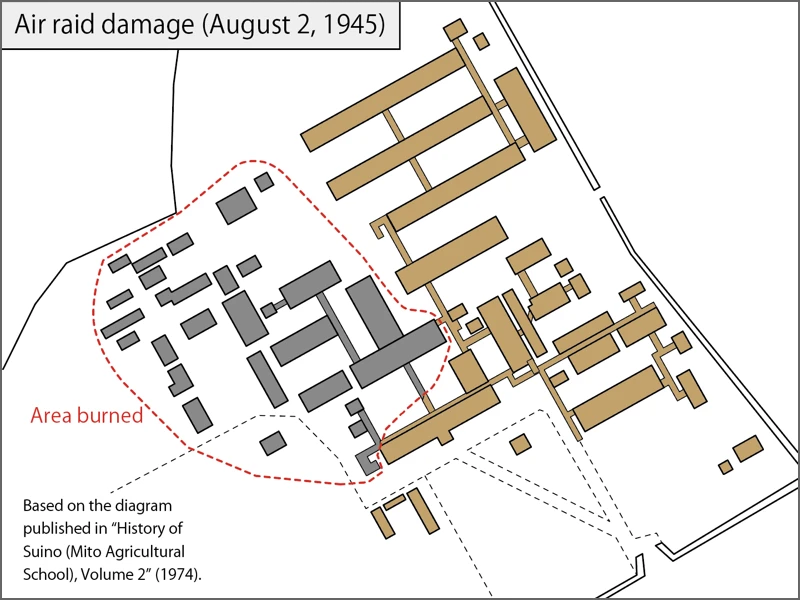
During the air raid on August 2nd, the western part of the Mito Agricultural School grounds was destroyed. Approximately half of the total building area was lost. The main building was spared from burning down thanks to the firefighting efforts of the students and inhabitants.
After the war, the Fundamental Law of Education and the School Education Act were enacted in 1947, leading to the establishment of the new junior high school system (1947) and high school system (1948).
Mito Agricultural School became Ibaraki Prefectural Mito Agricultural High School in 1948.
Subsequently, a new school building was constructed in Higashi-kinokura, Naka Town (present-day Naka City), located north of Mito City. The relocation was completed in February 1970. This marked the end of the agricultural school’s history at this location.
The details of the relocation process will be covered in the next installment.
(To be continued)
【References】
“History of Mito Agricultural School, Volume 1” (Mito Agricultural High School / 1970)
“History of Mito Agricultural School, Volume 2” (Mito Agricultural High School / 1974)