Visiting “Furusugi-an”
This is Chino City, Nagano Prefecture.
Last year, within the area of the Togariishi Historic Site Park, famous for the Togariishi Ruins, a reconstructed Jomon-period dwelling called “Furusugi-an” was built.
Designed and overseen by architect Terunobu Fujimori, it was constructed by participants from Japan and abroad during about ten workshops held from September to November last year.
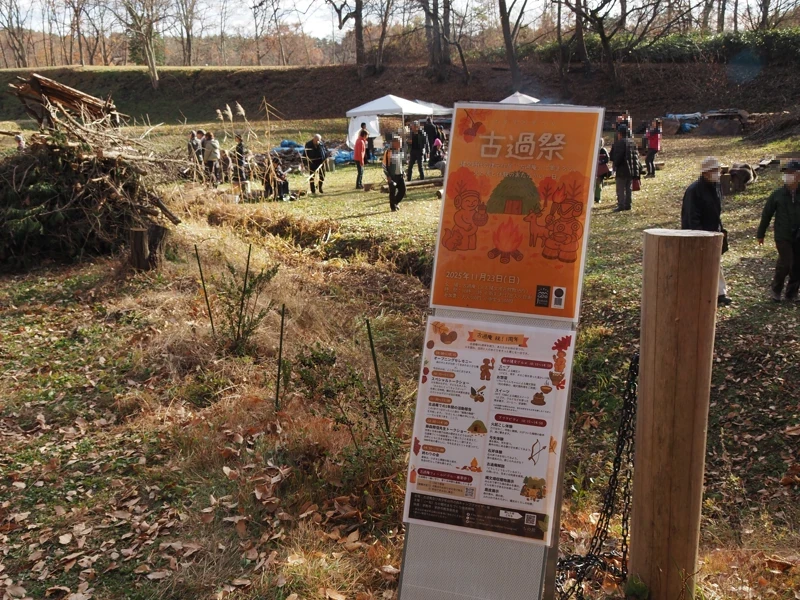
On Sunday, November 23rd, the “Furusugi Matsuri” (Furusugi Festival) was held to commemorate the first anniversary of Furusugi-an’s construction (hosted by the Chino Tourism and Community Development Promotion Organization).
The day featured activity reports, a lecture by Terunobu Fujimori, and hands-on experiences like fire-starting and archery.
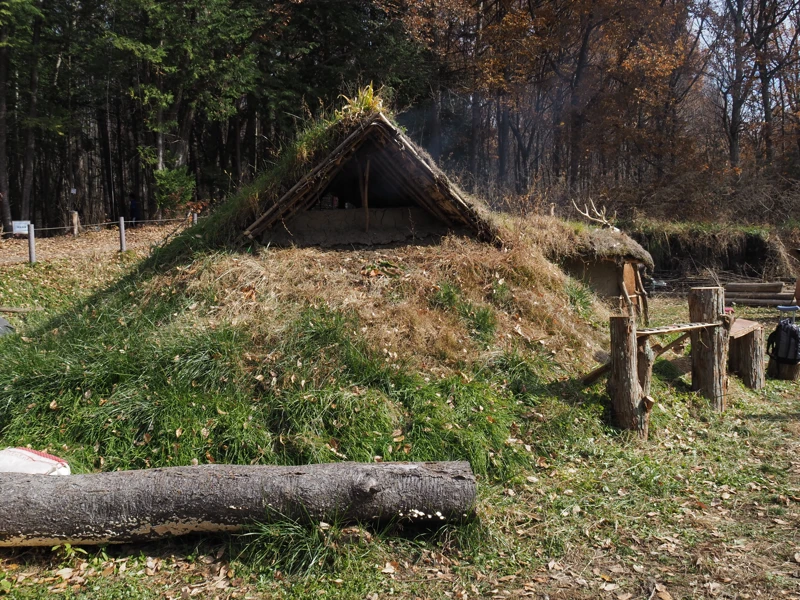
This is Furusugi-an.
When it was built last year, the roof was slightly lower, but it was modified this year to achieve this form.
The entrance looks like this.
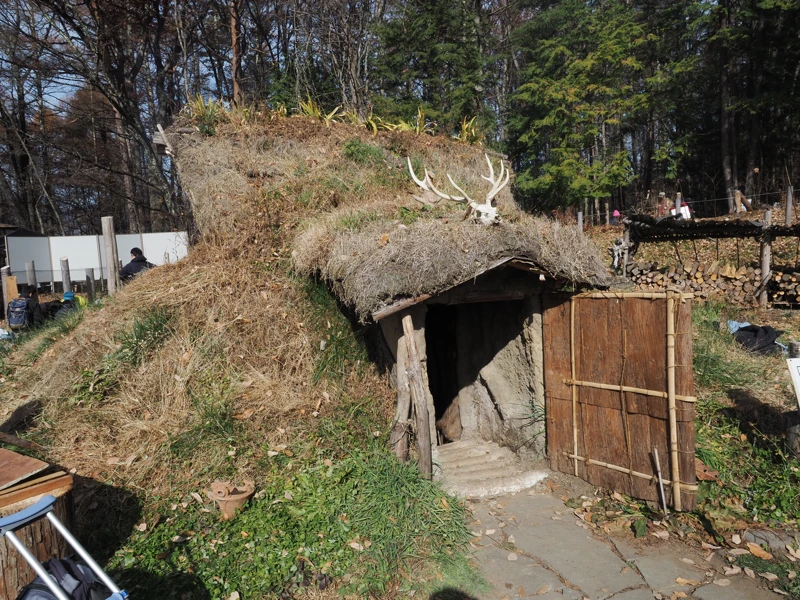
The dwelling measures approximately 4m in diameter and 2m in height, with the ground excavated 80cm below.
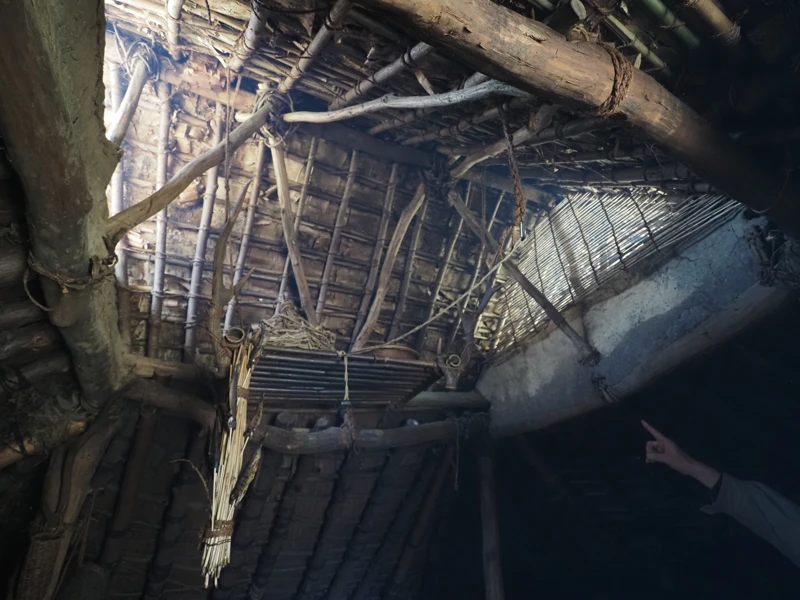
The pillars, beams, and roof trusses are made of chestnut wood, secured with ropes made from processed wisteria roots. The roof framework is constructed from cypress wood, covered with birch, sawara cypress, and cedar bark, then topped with earth.
The entrance is narrow, so we have to bend down to enter.
A hearth is dug in the center, with a fire burning.
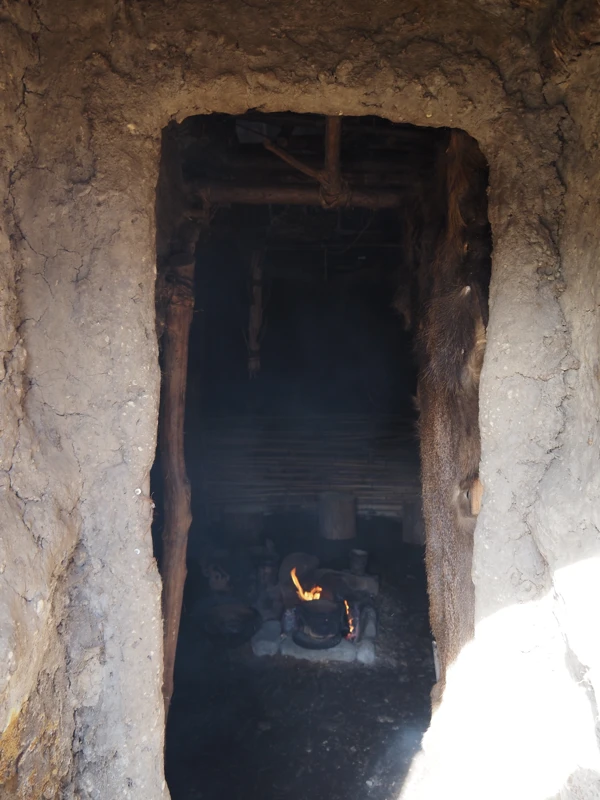
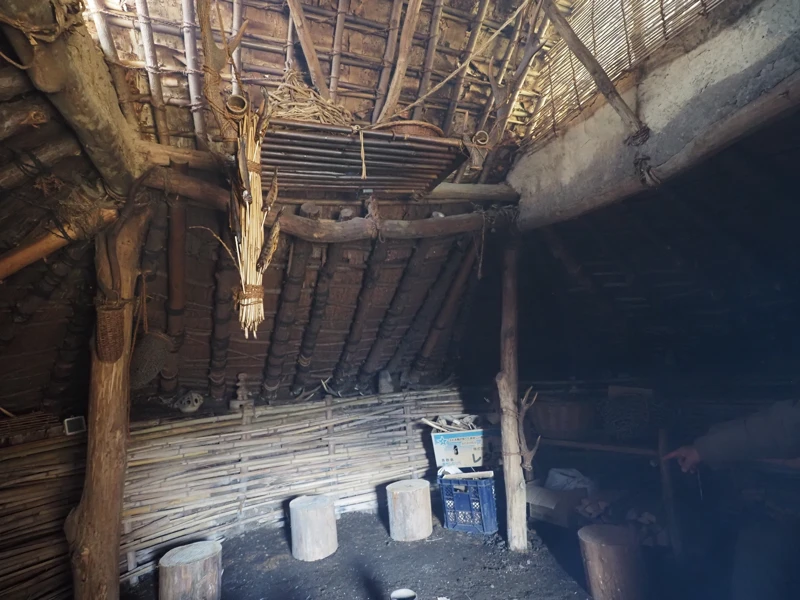
The interior view.
Four pillars stand, with the hearth in the center. Bamboo is woven and stretched across the lower part of the dwelling.
Looking up. We can see bark stretched over the roof frame.
But, the smoke stings my eyes.
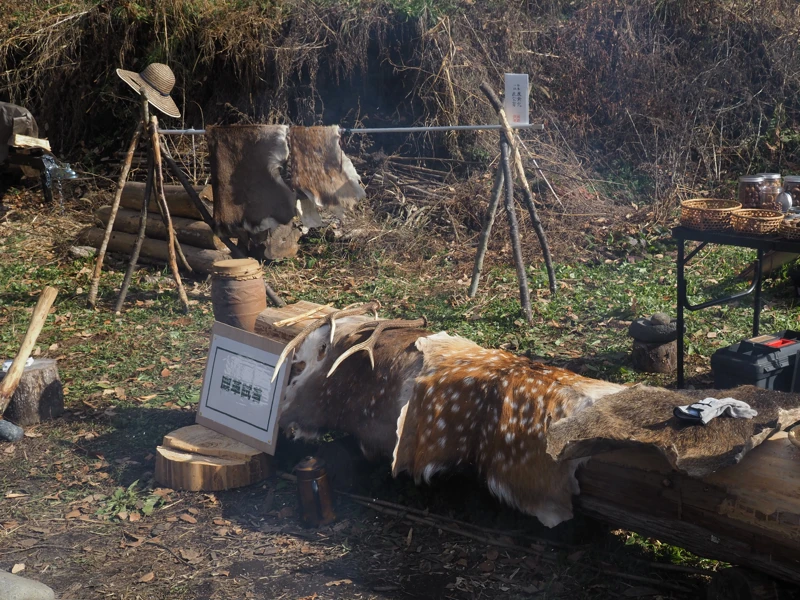
In front of the dwelling was an area where you could try on deer hides.
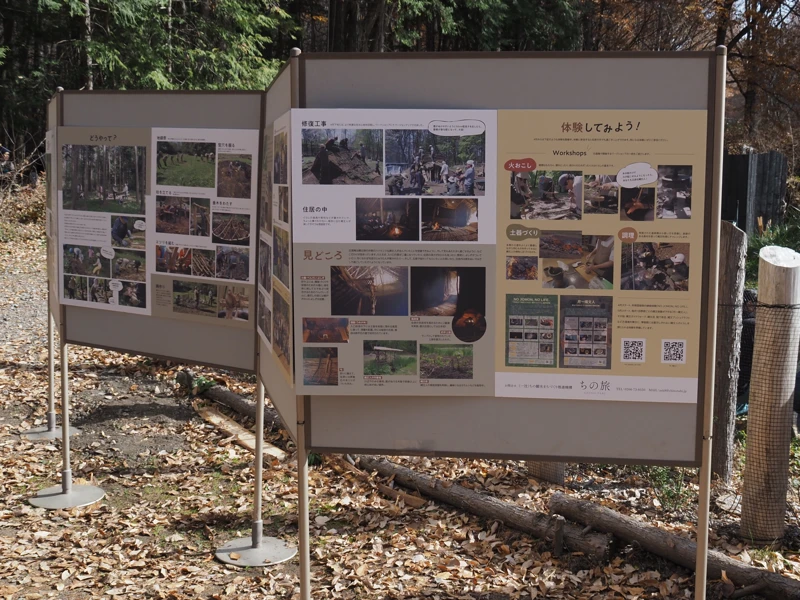
On the day, panels like this were displayed at the venue. They explained how the dwelling was constructed using photographs.
The pillars were felled from forest trees using stone axes, and ropes made from wisteria roots were used to secure them.
It seems they aimed to build using materials and tools available during the Jomon period as a principle.
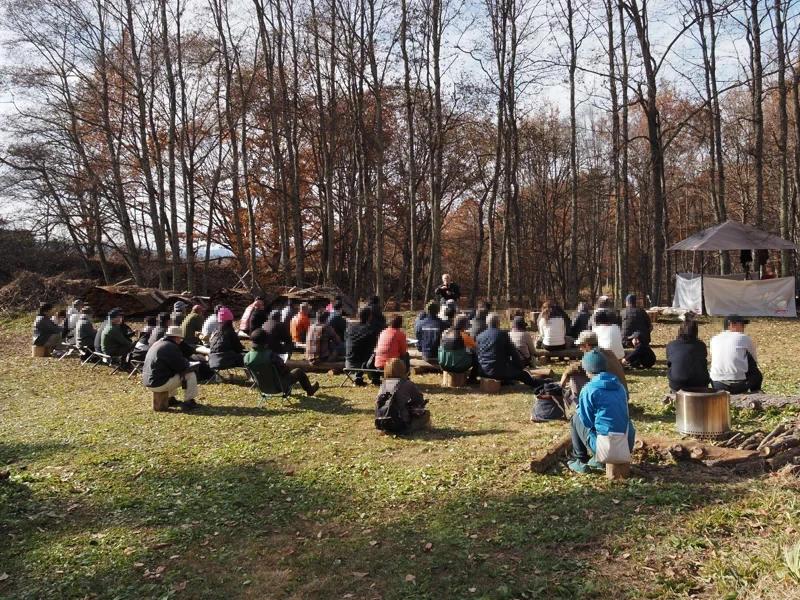
In the afternoon, Mr. Fujimori gave a lecture.
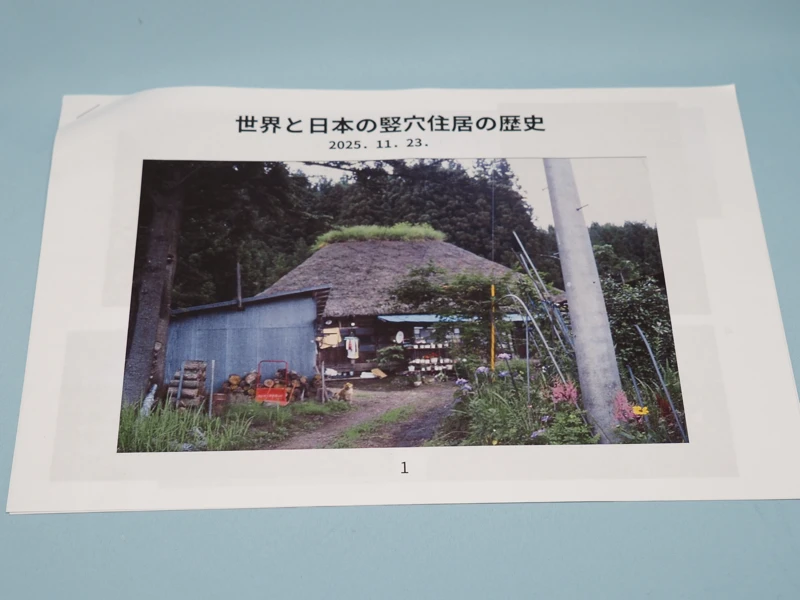
Since the lecture venue was outdoors, there were no slides, so these materials were distributed.
The handout included examples of earth-covered roofs not only from Japan but also from Northern Europe.
Mr. Fujimori has built Jomon-period pit dwellings several times in the past.
He mentioned that gathering thatch for the roofs was extremely difficult. He realized that harvesting thatch without iron tools was challenging.
This led him to question why the roofs of reconstructed Jomon dwellings were thatched with sedge.
While thatched roofs were the mainstream restoration method for Jomon dwellings in the past, this practice apparently began in 1951 when the first restored dwelling at the Toro Site in Shizuoka Prefecture used thatch. It seems the actual roofing material was unknown at that time.
Mr. Fujimori speculated that bark was likely used instead. He also considered whether the earthen roofing widely practiced in northern Eurasia might have existed in Japan as well.
The lecture then moved on to explaining earth-roofed buildings in Northern Europe, using photographs of reference materials.
The photographs of dwellings in Norway and Iceland were also fascinating.
After the lecture, I searched for information on Jomon-period dwellings to write this article.
While thatched-roof Jomon dwellings remain preserved nationwide as reconstructions of past structures, giving thatched roofs a strong image in the public mind, recent reconstructions increasingly feature earthen roofs.
At the Goshono Site in Ichinohe Town, Iwate Prefecture, a 1996 survey confirmed it was an earthen-roofed dwelling based on charred pillars, roof materials, and the accumulation of burnt earth.
Earthen-roofed dwellings have also been reconstructed at sites like Kitadai in Toyama City, Miyahata in Fukushima City, Katsuzaka in Sagamihara City, Kanagawa Prefecture, and Umenoki in Hokuto City, Yamanashi Prefecture.
I, too, had the image of Jomon dwellings having thatched roofs, so I want to revise my understanding.