Tatsugaike and Sunayamaike Pumping Station (1)
This photograph shows a pump installed at the student entrance of former Toyosato Elementary School.
The sign below indicates the product name as “The Conqueror Pump.” It was manufactured by W.H. Allen Son & Co. LTD in the United Kingdom.
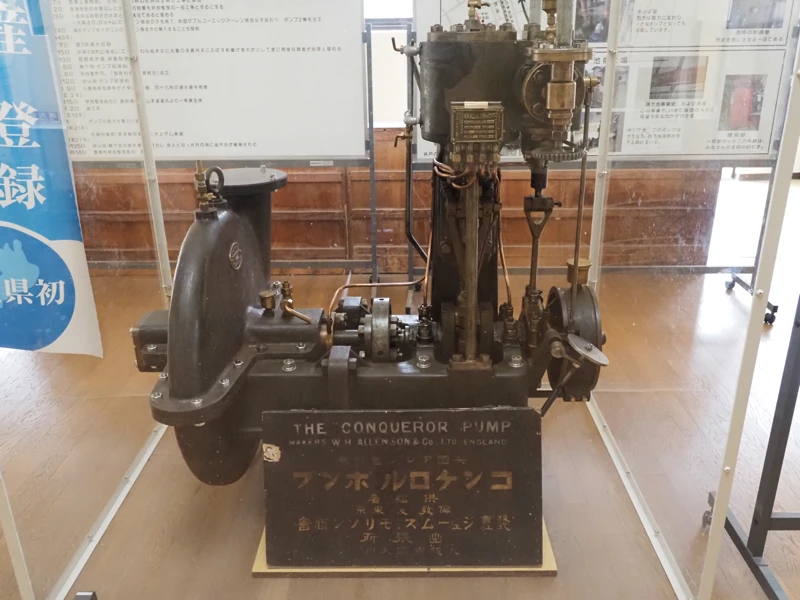
This pump was apparently used at the Tatsugaike Pumping Station to draw water for agricultural use in the past.
Several explanatory panels are erected immediately beside the pump.
The panels bore the inscription “The History of Tatsugaike and Sunayamaike.”
According to this, in 1910, pumping stations were constructed in the Shijukuin and Ishihata districts of Toyosato Village to draw groundwater for agricultural use.
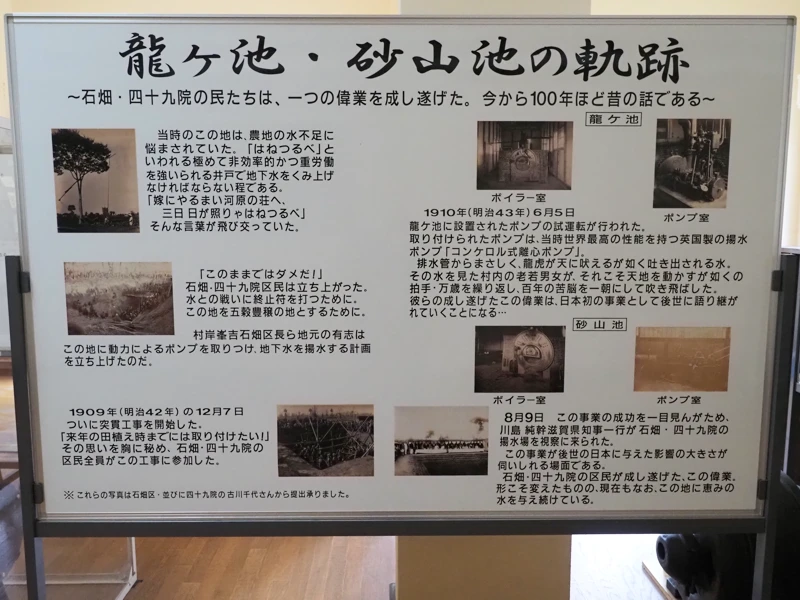
At that time, this region suffered from water shortages for farmland. Water disputes frequently arose over drawing water from the Inukami-gawa River, and drawing water from wells required manual labor using a pole with a bucket (shadoof). Even these wells often dried up during droughts.
In 1909, hit by drought, plans were made in both the Ishihata and Shijukuin districts to implement power-driven water pumping. Test drilling began on December 6th, and full-scale construction involving all district residents started on the 27th.
The following June 1910, trial runs of the pumps at Tatsugaike and Sunayamaike were conducted. As the water volume was sufficient, the Toyosato Village Farmland Consolidation Association was established to advance the powered water pumping project.
At that time in Japan, while pumps were in use, they were either employed at water-rich lakes and marshes or large rivers as water sources, or conversely, used solely as drainage pumps. There were no known cases of installing agricultural water pumps utilizing groundwater. Consequently, this plan was viewed skeptically by those around them, and some prefectural officials even publicly declared the project would fail. However, it was decided that the prefectural governor and others would come for an inspection in August.
Subsequently, bank protection work and canal improvement work were carried out, and a completion ceremony was held on November 2, 1913.
Initially powered by steam pumps, the facility was electrified in 1923 and remains operational today (*).
In 2014, the Sunayamaike and Tatsugaike Stations were selected as Recommended Civil Engineering Heritage by the Japan Society of Civil Engineers. Tatsugaike was registered as a World Irrigation Heritage site in 2024.
(* According to a May 19, 2025, article in the Chunichi Shimbun, the Tatsugaike Pumping Station has not been operational since it malfunctioned in 2020. The article also stated that no future utilization plan had been decided. I do not know if there has been any progress since then.)
Let’s go see the facility.
First, we’ll tour the Sunayamaike Pumping Station. The pumping station was located right next to the Tokaido Shinkansen tracks.
This is the view from the west (west-northwest). The land has been excavated and stone walls built. The stone wall section is 3.6m wide and 29m long, with a well dug here. A building housing the pumps is constructed beside the well. The lower part of the building is brickwork.
The site is fenced off, so entry is not possible.
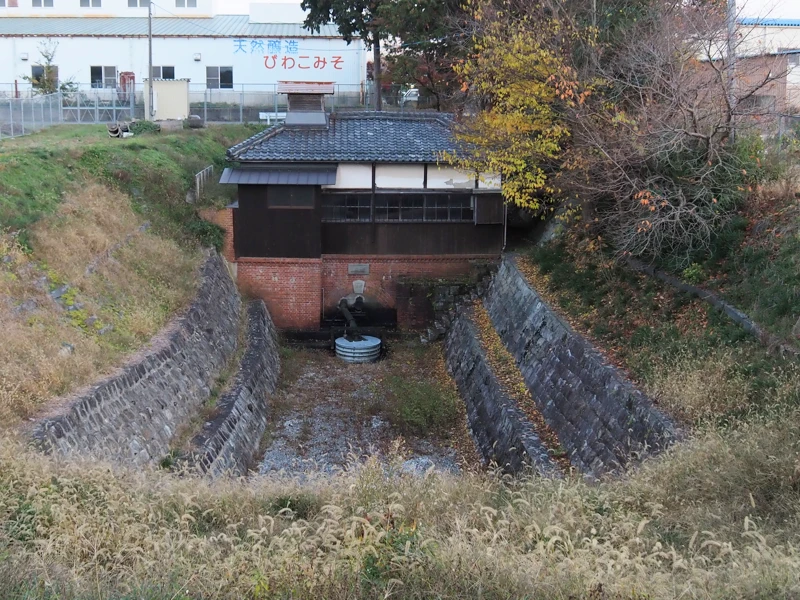
I took photos while moving around the perimeter. Pipes connected underground are visible.
Stone plate is installed atop the brick walls. Though indistinguishable from here, they are said to bear the inscription “Seiko” (= to honor achievements).
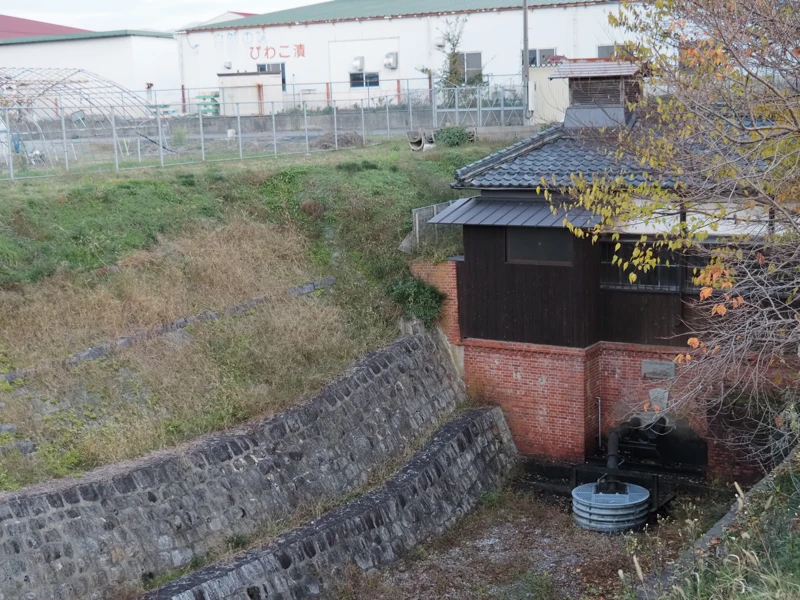
I moved around to the east side (east-southeast). I reached over the fence to take photos.
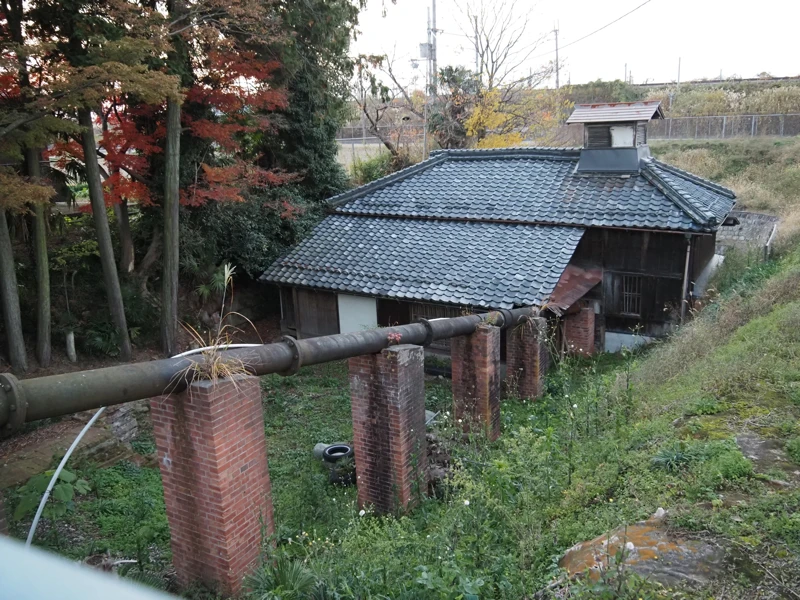
Brick pillars are erected with pipes laid across them. The pumped water likely rises up through here.
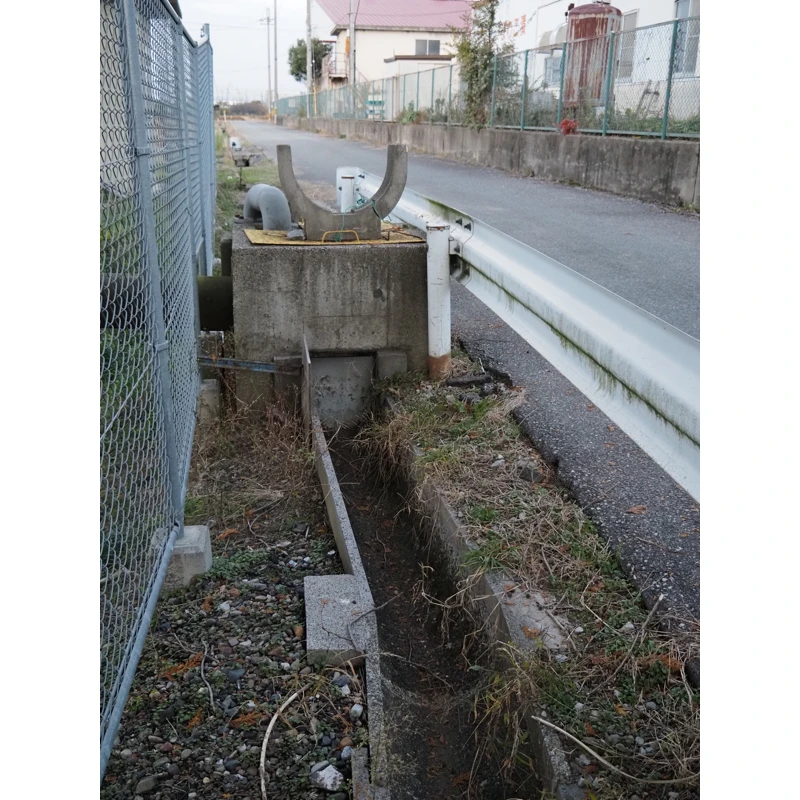
The water appears to flow into the irrigation ditch beside the road. It wasn’t flowing because it was winter, though.
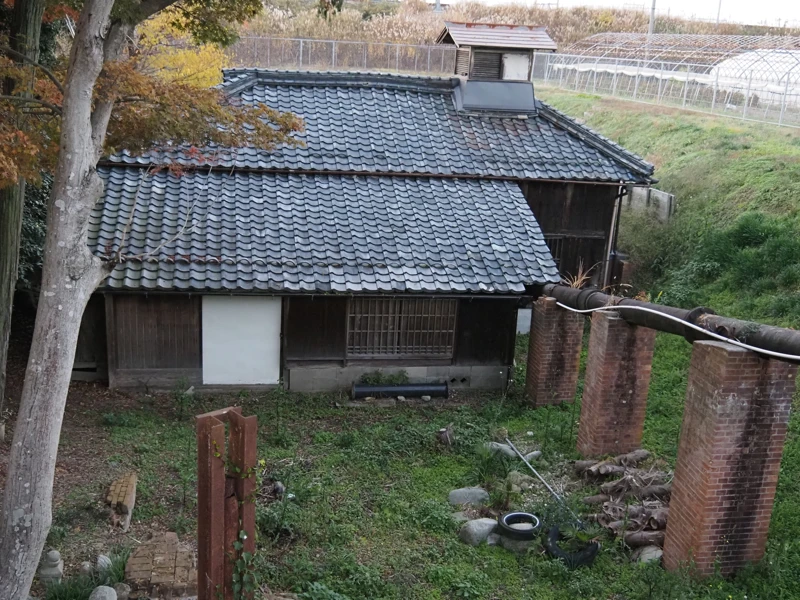
This was also photographed over the fence.
The pumping stations at Sunayamaike and tatsugaike were among Japan’s earliest facilities using steam pumps to draw groundwater. Seeing the success of this project, more districts within Shiga Prefecture established associations and began excavating water sources and installing pumping equipment.
It is said that observers visited not only from the local area but from all over the country.
Now, let’s move on to the Tatsugaike Pumping Station.
(To be continued.)
[References]
“Agricultural Electrification” Vol. 4, No. 10 (Agricultural Electrification Association ed. / Agricultural Electrification Association / October 1930)
“Toyosato Village history” (by Fujikawa Sukezo / Toyosato Village History Editorial Committee, Inukami County, Shiga Prefecture / 1963)