The Water Supply Tower for Lowland, Mito City Waterworks
I visited Mito City.
Having previously created pop-up cards for the former Ibaraki Prefectural Office (now the Sannomaru Government Building) and the The Water Supply Tower for Lowland, Mito City Waterworks, I was determined to see the actual buildings when I went to Mito City.
So, this time, I’ll write about the Water Supply Tower for Lowland, Mito City Waterworks.
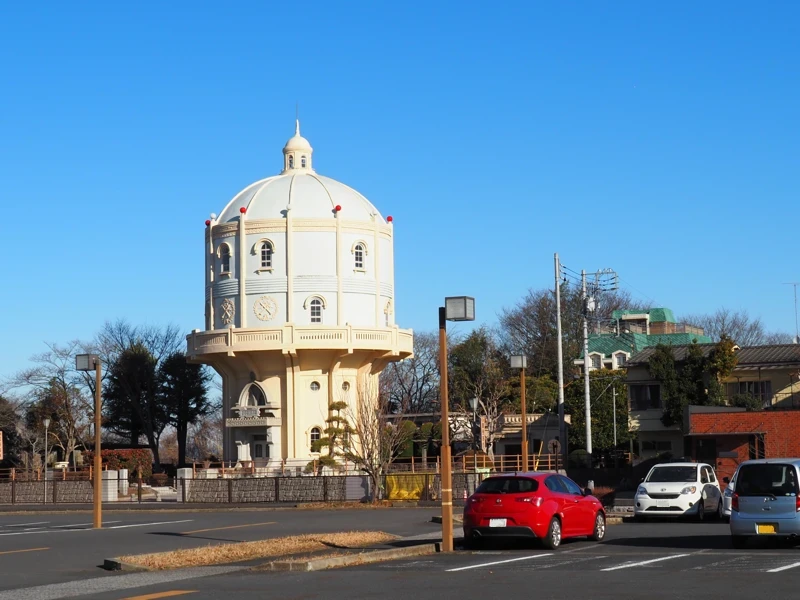
The water tower is located very close to the Ibaraki Prefectural Sannomaru Government Building.
Mito City, which implemented its city ordinance in 1889, has expanded and improved its waterworks ever since.
In 1924, Mito City began investigations aiming to supply water throughout the entire city. From 1928, they studied the realization of a citywide water system, and construction approval was granted in July 1930.
Mito City is centered around Mito Station, with the northern and western areas being plateau terrain, while the eastern and southeastern areas are lowlands. Due to an elevation difference of approximately 24 meters, the city was divided into “Highland (plateau)” and “Lowland” for water distribution.
The water source plan involved diverting underground water from the Nakagawa River’s sandbar. Water would be pumped from the purification plant to the Highland Water Tower (then located in Koyama, Watari Village) and the Lowland Water Tower (in Kamiichi Kita-sannomaru, Mito City), from which it would be supplied to individual households.
Construction of the waterworks project commenced in November 1930.
Construction of the Lowland Water Tower began in 1931 and was completed in 1932.
The characters “Lowland Water Tower” are engraved above the entrance.
Waterworks engineer Goto Tsurumatsu was responsible for the design and construction supervision.
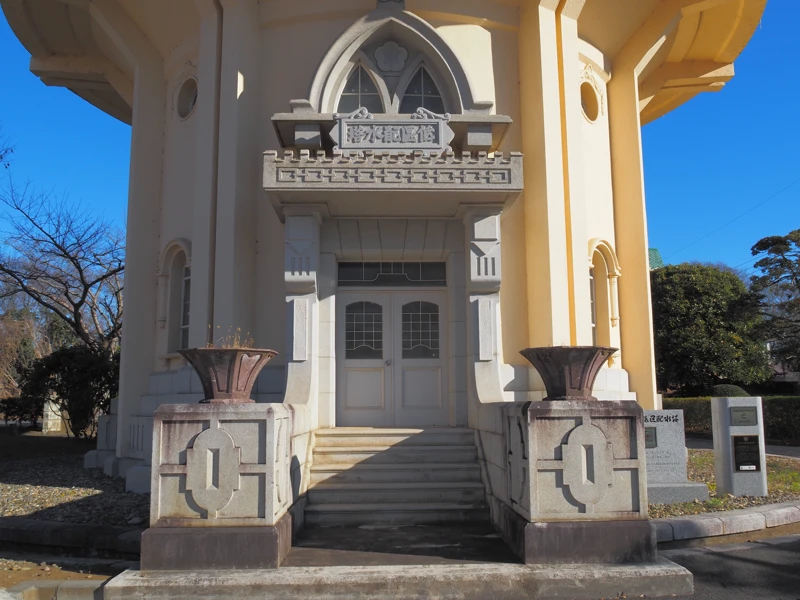
The tower stands 21.6 meters tall with a diameter of 11.2 meters, constructed of reinforced concrete. It houses a water tank at the top with an inner diameter of 8 meters and a capacity of 358 cubic meters. The first floor contains an office, and a central spiral staircase leads to the upper levels.
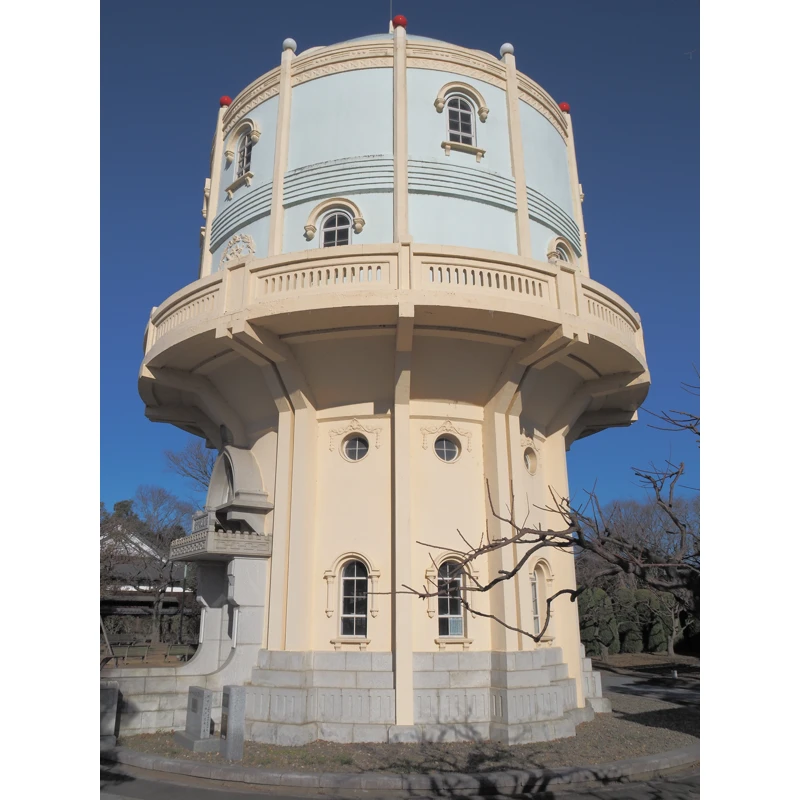
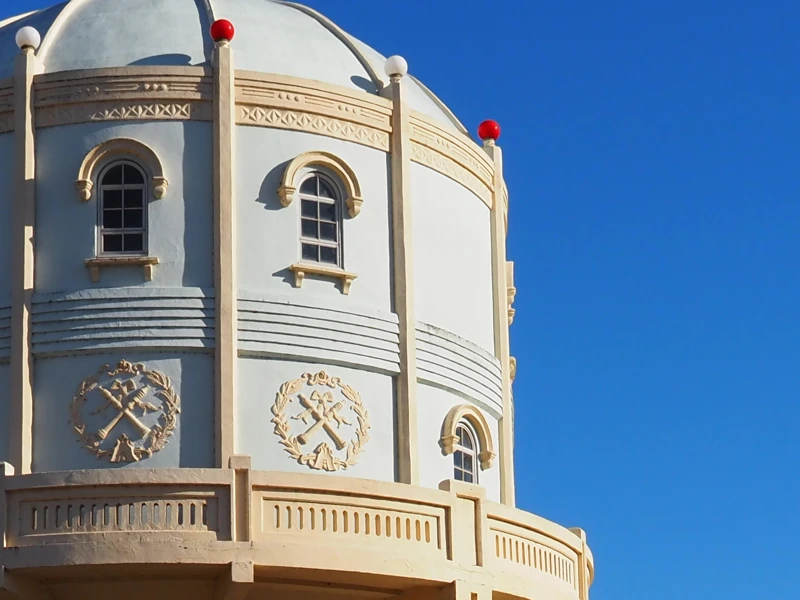
Its walls are adorned with windows and reliefs. Immediately after its completion, it became a beloved landmark in Mito City, symbolizing the modernization of civic life.
The relief design appears to depict fire hose nozzles.
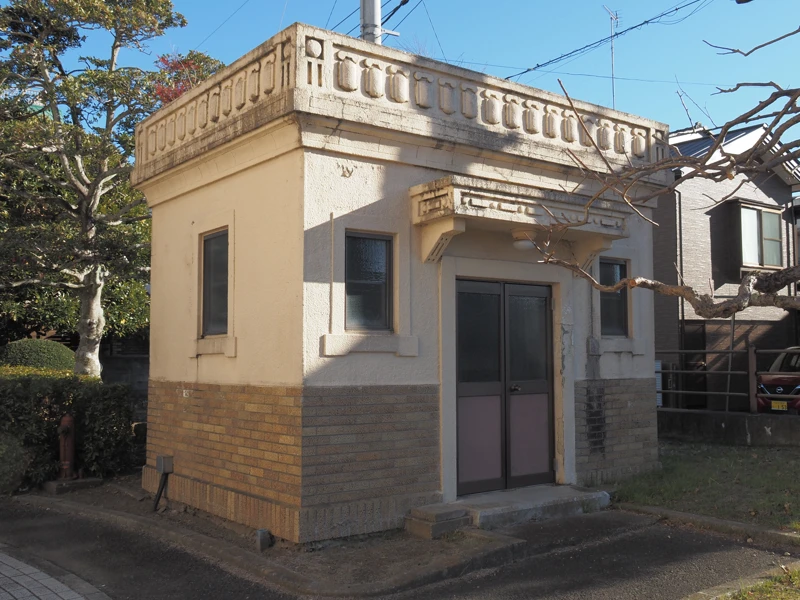
This is the flow meter room located within the site.
I neglected to check, but the site also includes a former blacksmith’s workshop where tools were repaired.
During the war, Mito City also suffered air raids. In the air raid on August 2, 1945, 80% of Mito City was destroyed by fire, including the waterworks office within City Office. A temporary office was set up on the grounds of the Lowland Water Tower, and efforts to supply water continued. Damage to waterworks facilities from this air raid amounted to over 690,000 yen. Before the war, the system supplied water to 8,500 households and over 40,000 people. But by December 1945, after the war, the number of households served had dropped to 1,600, supplying water to just over 8,100 people. At times, water leakage exceeded 60% of the total distribution volume.
Due to postwar material shortages, full restoration reportedly took until around 1950.
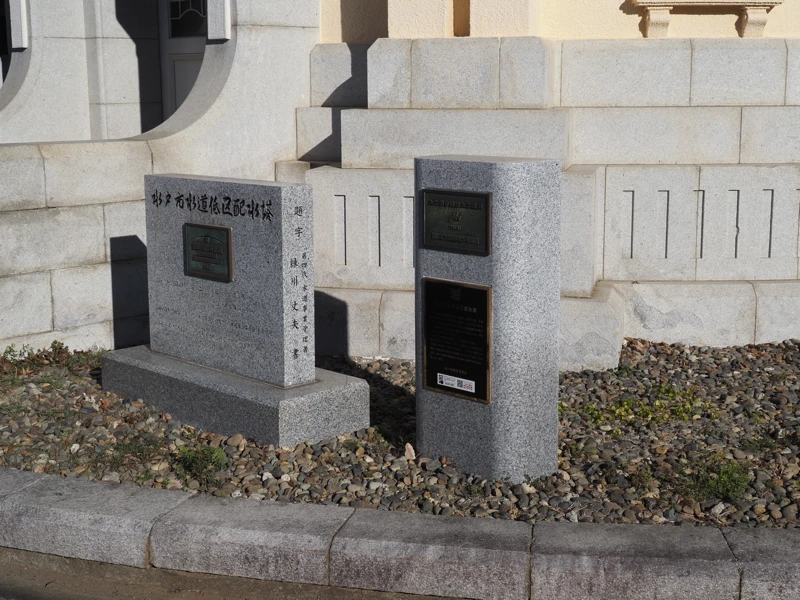
Two monuments stand beside the water tower.
The left monument bears a Registered Tangible Cultural Property plaque, inscribed with the completion year, tank capacity, and designer’s name. It also notes the tower’s designation in 1985 as one of the “100 Selected Modern Waterworks” and its registration as a Tangible Cultural Property in 1996.
The right monument features a plaque commemorating its selection in 2014 as a Civil Engineering Heritage Site by the Japan Society of Civil Engineers.
The rear of the water tower.
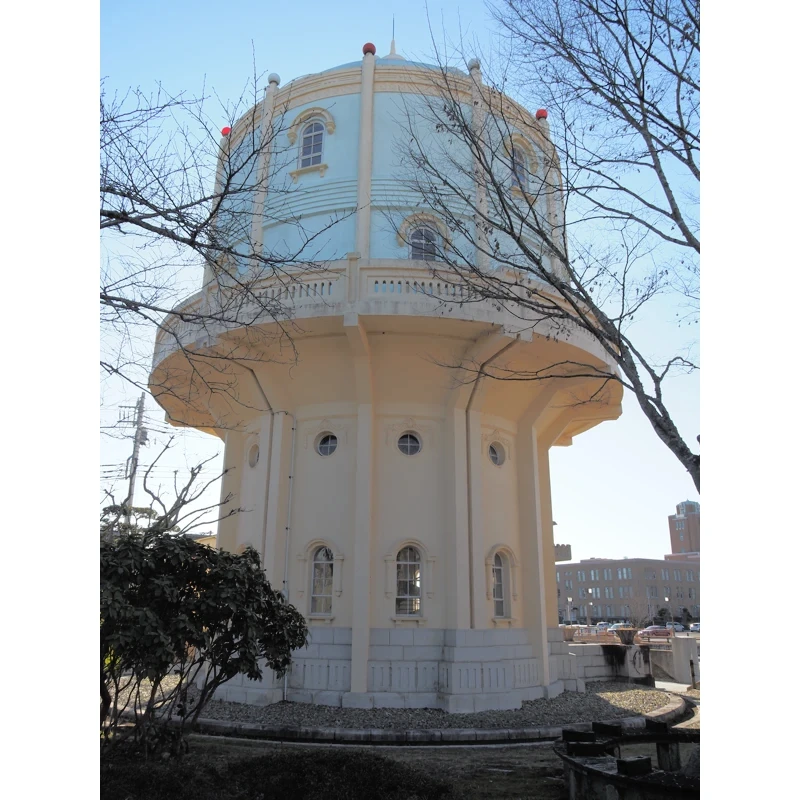
The water tower ceased operation in March 2000 due to durability concerns, but it was preserved as a symbol of modern waterworks.
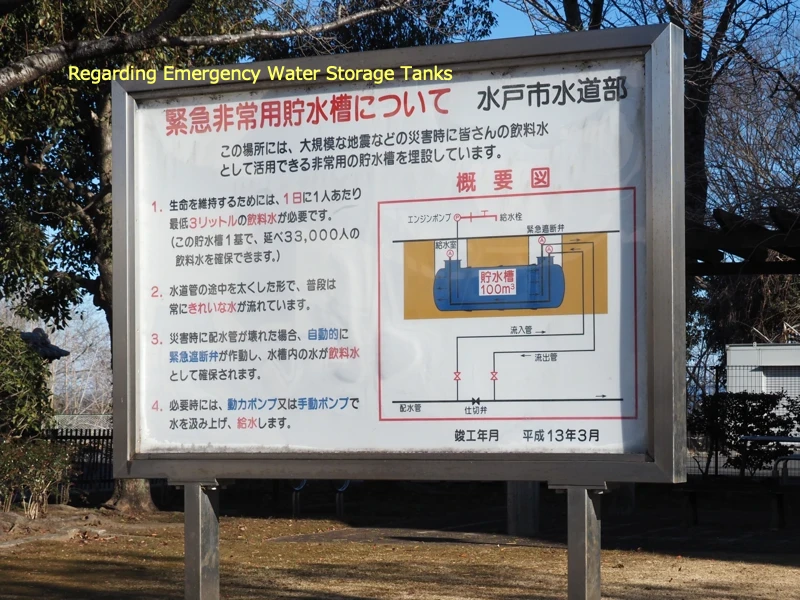
An emergency water storage tank for disaster preparedness is installed underground in the adjacent Sannomaru Green Space. It was completed in March 2001.
Normally connected to water mains with flowing water, if disaster damages the distribution pipes, an automatic emergency shut-off valve activates. This secures 100 cubic meters of water from the tank as potable water, which is then pumped for supply.
Finally, let me refer on the Highland Water Tower, built in 1932 like the Lowland Water Tower.
The Highland Water Tower was built about 100 meters northwest of the current Ibaraki University campus (which housed the 2nd Infantry Regiment at the time). Its steel water tank measured 10.3 meters in diameter and 6.18 meters in height, with a hemispherical base and a capacity of 757 cubic meters. Eight steel columns supported the tank, giving the entire tower a height of 41.3 meters.
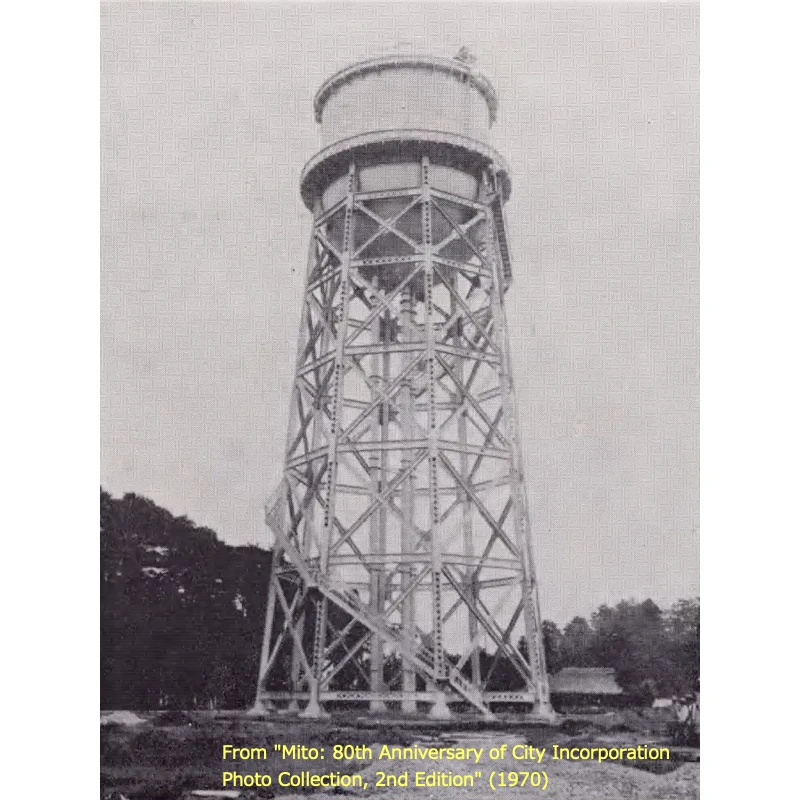
In 1985, the Ashiyama Water Purification Plant, along with the Highland Water Tower and Lowland Water Tower, was selected as one of the “100 Selected Modern Waterworks” by the Ministry of Health and Welfare.
However, the tower ceased operations in 1998 and was dismantled the following year.
[References] (All written in Japanese)
“Mito City Waterworks Installation Prospectus” (published in the magazine “Suido,” February 1932 issue / 1932)
“History of Mito’s Waterworks, Volumes 1-3” (compiled by the Mito City Waterworks Department History Compilation Committee and the Ibaraki History and Geography Society / Mito City Waterworks Department / 1984)
“History of Mito City, Part 2, Volume 3” (Compiled by the Modern and Contemporary History Special Committee of the Mito City History Compilation Committee / Mito City / 1998)