History of Georgia and Tbilisi
This is also research for making pop-up cards.
Next, I plan to create some pop-up cards modeled after buildings in Tbilisi, the capital of Georgia.
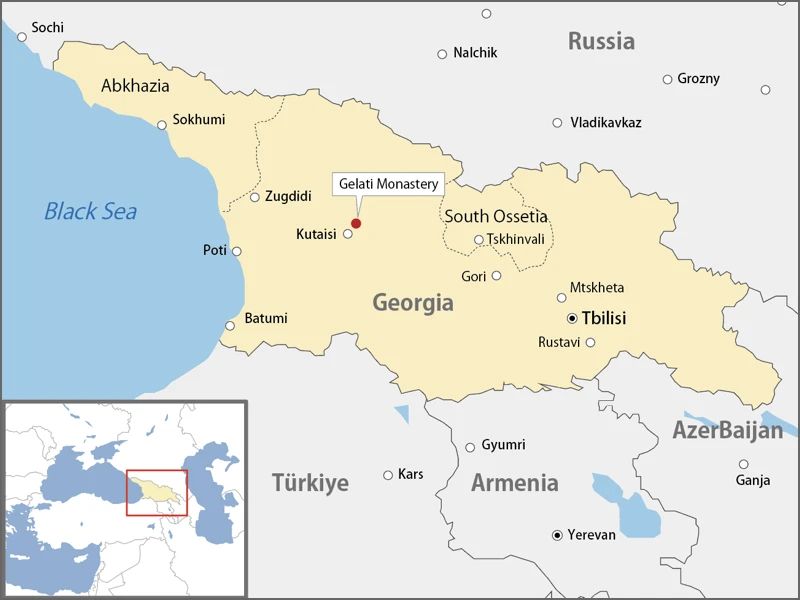
Georgia is located on the eastern shore of the Black Sea, bordering the Russian Federation to the north and Azerbaijan, Armenia, and Turkey to the south. And the western region of Abkhazia and the northern region of South Ossetia are de facto independent states, although Georgia does not recognize them and most UN member states do not either, .
The Caucasus region, sandwiched between the Black Sea and the Caspian Sea, has been inhabited since ancient times. The Kingdom of Iberia existed there from the 4th century BC to the 6th century AD.
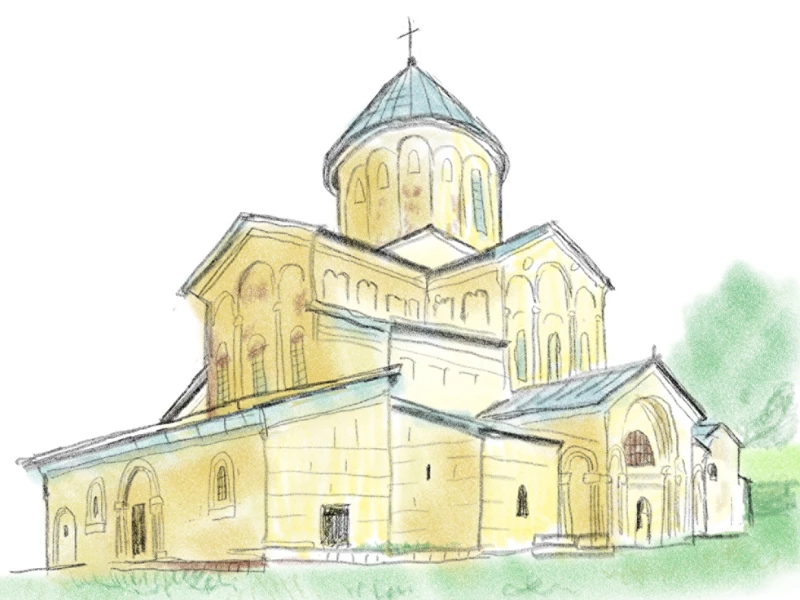
In the early 11th century, the Kingdom of Georgia was established in this region, flourishing greatly from the late 11th to the 13th century. Its culture blossomed in architecture and painting, with Christian art and secular culture developing. The Gelati Monastery, a World Heritage Site, was built during this era (founded in 1106).
Georgia subsequently declined due to invasions by the Mongols and Timur, compounded by the plague. By the end of the 15th century, the Kingdom of Georgia collapsed and fragmented into several kingdoms and principalities.
One of these kingdoms, the Kingdom of Kartli, included Tbilisi within its territory. The Kingdom of Kartli was under Persian rule from the mid-16th century to the mid-17th century. In 1762, it united with the Kingdom of Kakheti to form the Kingdom of Kartli-Kakheti. The kingdom’s territory roughly corresponded to the eastern half of present-day Georgia, with its capital in Tbilisi.
The Kingdom of Kartli-Kakheti became a protectorate of the Russian Empire in 1783, but was subsequently invaded by the Qajar dynasty of Persia, resulting in the occupation of Tbilisi. Although the Persian occupation was temporary, amid the ensuing turmoil, the Kingdom of Kartli-Kakheti was annexed by the Russian Empire in 1801.
Tbilisi came to be called Tiflis in the Russian style, and Government-General’s Office was established there.
The 19th century saw industrial development through the establishment of railways, mines, and factories. However, the benefits accrued primarily to Russians, Armenians, and Western European nations, leaving Georgians with few advantages.
Entering the 20th century, peasant and labor movements spread. During the 1905 peasant uprising, while martial law was declared in Georgia, and Russia sent troops to suppress the uprising.
The riots and unrest within Russia at this time are known as the First Russian Revolution.
In 1917, the collapse of Imperial Russia following the Second Russian Revolution led to Russia retreating northward and Turkey advancing into the region. In 1918, the countries of the Caucasus region formed a federation, establishing the Transcaucasian Democratic Federative Republic. However, differences in stance toward Turkey led to the dissolution of the federation.
That same year, under the protection of German forces, the Democratic Republic of Georgia was established.
However, Georgia found itself at war with Armenia and Azerbaijan, and the country was in turmoil. Although recognized as an independent state, Georgia was denied membership in the League of Nations in 1921.
That year, Joseph Stalin and Sergo Ordzhonikidze, both natives of Georgia, launched military operations, and the Red Army occupied Tbilisi. In February, the Georgian Soviet Socialist Republic was proclaimed.
Though it subsequently became a Soviet republic, Georgia maintained strong anti-centralist sentiments, and popular movements reportedly occurred frequently from the 1950s onward.
In April 1989, demonstrations demanding independence from the Soviet Union took place in Tbilisi. They were suppressed by Soviet troops, resulting in 19 deaths and hundreds of injuries. (The Tbilisi Massacre. The death toll was the official figure; it is said the actual number was higher.)
In 1990, Georgia adopted a declaration of sovereignty and changed its name to the Republic of Georgia. The following year, a referendum approved independence, and a declaration of independence was issued.
Meanwhile, ethnic minority issues erupted domestically. South Ossetia declared independence in 1991, followed by Abkhazia in 1992, plunging the country into civil war.
Even after entering the 21st century, a conflict erupted between Georgia and Russia over South Ossetia in 2008, leading Georgia to sever diplomatic relations with Russia.
Starting the following year, the Georgian government began requesting countries to change the name they use for the country from the Russian-derived “Gruziya” to the English-derived “Georgia.”
Japan changed its name usage in 2015.
I’ve roughly traced Georgia’s history. While I still don’t fully understand it, learning about the history helped me grasp the architectural image of Tbilisi a little better.

This map identifies buildings in Tbilisi based on Google map, Wikipedia and tourist guides. (I only included what caught my eye, so some representative buildings I might missed.)
The oldest structure on this map is Narikala Fortress, said to have been built in the 4th century. The fortress was constructed atop a mountain overlooking the plain below and was used by subsequent rulers, undergoing additions and renovations.
Churches built during the medieval to early modern periods still stand on flatlands and mountainsides. Some churches, closed during the Soviet era, remain sealed off to this day.
The northern part of the map features buildings such as theaters constructed in the 19th century, which date back to the Imperial Russian era.
Among 20th-century architecture, the National Library and National Museum were built during Imperial Russia, while the Parliament Building was constructed during the Soviet era.
Searching online for Georgian architecture reveals people focusing on Soviet-era buildings. While not included on the map because they fall outside its scope, structures like the former Transport Ministry building (now the Bank of Georgia), the Palace of Ceremonies, and the Archaeological Museum seem to attract some attention.
Furthermore, searching for “Tbilisi tourism” often brings up buildings constructed in the 21st century (shaded gray on the map).
Of course, older buildings are listed as tourist attractions, but the Holy Trinity Cathedral (2004) and the Bridge of Peace (2010) are also mentioned.
I’m about to start making pop-up cards. While I definitely want to create churches from the medieval to early modern periods, I also want to try making buildings from the Russian or Soviet eras.
I’ll update the main site once they’re finished.
[Reference]
“Georgia (country)” (Wikipedia / accessed December 21, 2025)
“History of Georgia” (Wikipedia / accessed December 21, 2025)
“Tracking down mysterious Soviet architecture found in the former Georgia.” (Casa BRUTAS, March 18, 2016) (written in Japanese)